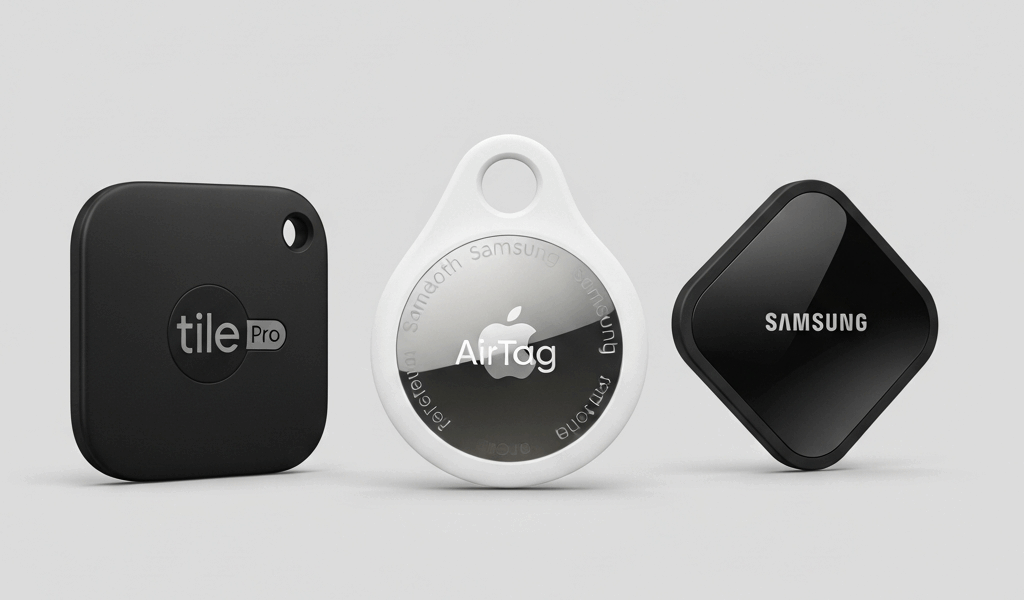
AirTag vs Tile vs SmartTag — Which Bluetooth Tracker Wins?
The AirTag vs Tile vs SmartTag debate sounds like a fair fight until you realize the answer is almost entirely determined by the phone in your pocket. I’ve been running all three trackers simultaneously for about eight months now — one on my keys, one in my laptop bag, one stuffed inside a travel wallet — and the honest conclusion I reached pretty fast is that these products compete less with each other than they compete for ecosystem loyalty. Pick the wrong one and you’re not just buying a subpar tracker. You’re fighting your own phone every time you try to find something.
That said, the details underneath that headline verdict matter. Network size, precision finding, battery life, and an increasingly important conversation around anti-stalking protections all factor into which tracker you should actually spend money on. Let’s get into it.
The Quick Verdict by Phone
I’ll put this right at the top because burying it would be dishonest. Probably should have opened with this section, honestly — every review I read before buying made me wade through six paragraphs of spec comparisons before telling me what actually mattered.
Here’s the short version:
- iPhone user? Buy the AirTag. Full stop.
- Samsung Galaxy user? Buy the SmartTag2. It integrates directly into your phone in ways no third-party tracker can replicate.
- Android user on any other device? Tile is your only real option with a mature, dedicated app and cross-platform consistency.
The reason this matters so much is that Bluetooth trackers don’t just beep when you’re standing next to your lost keys. Their real value is in the crowd-sourced finding network — anonymous pings from other phones that update your tracker’s location even when you’re not nearby. That network is entirely ecosystem-dependent. An AirTag pinging off Android phones contributes nothing to its location history. A Tile pinging off Samsung phones only updates if those Samsung owners also happen to have the Tile app installed.
I learned this the hard way. I left my laptop bag at a coffee shop in Denver last spring and checked the Tile app on my iPhone expecting near-real-time updates. The bag sat there for forty minutes showing the same location because almost no one in that particular shop had Tile installed. An AirTag in that same bag would have been pinging off every iPhone within range — and there are a lot of iPhones in Denver coffee shops. Lesson absorbed, painfully.
Finding Network Size
This is where the real differentiator lives, and the numbers are not close.
Apple’s Find My network runs on over one billion active Apple devices globally. Every iPhone, iPad, Mac, and AirPod participates passively and anonymously. You don’t opt into it — it’s just running in the background on every Apple device by default. That density means an AirTag lost in any reasonably populated area has an extraordinary chance of being pinged within minutes.
Samsung’s SmartThings Find network, which powers the SmartTag2, is built on the back of Samsung’s Galaxy device install base — somewhere north of 200 million active devices. That’s legitimately substantial. In markets where Samsung dominates (South Korea, large parts of Southeast Asia, much of Europe), SmartThings Find is genuinely competitive. In the United States, where iPhone holds about 55 percent of the market, it’s more of a coin flip whether a Samsung device is nearby when you need one.
Tile’s network is the weak point. Tile relies entirely on people who have the Tile app actively installed on their phones — not passive participation, but an explicit app download. Tile hasn’t published network size numbers recently, and that silence is telling. The app has millions of installs, sure. But “millions of installs” is vastly smaller than “every iPhone on the planet.” Frustrated by a lost Tile tracker that sat at an unknown location for three hours, I tested this by leaving a Tile in my car in a suburban parking lot and watching the location timestamps. It updated once in 90 minutes. My AirTag in the same lot updated seven times.
The network gap is the single most important technical factor in this comparison. Precision finding and design are nice. Being able to actually locate your stuff is the point.
Range, Battery, and Build
Hardware specs are where the conversation gets more nuanced, and where the AirTag and SmartTag2 genuinely pull ahead of Tile — though not for the reasons most people expect.
All three trackers use CR2032 coin cell batteries. The AirTag’s battery lasts roughly a year under normal use, and replacing it costs about $3 at any pharmacy. The SmartTag2 also runs on a CR2032 with Samsung claiming about six months of life, though my personal unit has been running for four months without a low-battery alert. Tile’s various models (the Tile Mate, the Tile Pro, the Tile Slim) also use CR2032 batteries or built-in rechargeable cells depending on the model — the Tile Slim uses a built-in battery that requires USB-C charging, which is convenient until the battery degrades and the whole unit becomes landfill.
Bluetooth range is roughly equivalent across all three. Expect reliable connection at around 30 feet under normal indoor conditions. Walls, interference, and metal objects all cut that number. None of them are going to beep from across a parking garage. That’s not what they’re for.
Ultra-Wideband — UWB — is where the AirTag and SmartTag2 separate themselves from Tile. UWB is a short-range radio technology that allows for centimeter-level spatial accuracy rather than the room-level accuracy of standard Bluetooth. On an iPhone 11 or newer (and many Samsung Galaxy S21 and newer devices), UWB enables “Precision Finding” — a guided arrow on your screen that physically points you toward your lost item, updating in real time as you move around a room. I’ve used it to find my keys stuffed between couch cushions in under ten seconds. It works the way the demo videos promise, which is not always true of consumer electronics.
Tile has no UWB. None of their current lineup. You get a Bluetooth signal strength indicator that gets stronger as you get closer — the old “hot or cold” approach. It works. It’s slower. In my experience, finding a Tile-tracked item in a cluttered space takes about twice as long as finding an AirTag with Precision Finding active.
Build quality: The AirTag is a white plastic disc, 31.9mm in diameter, 8mm thick. It has no built-in attachment point, which is a genuine design oversight — Apple sells $29–$39 keyrings and loops separately, which is an absurd add-on cost for a $29 tracker. The SmartTag2 has a built-in loop. Tile’s Mate model also has a keyring hole built in. If you’re putting these on keys, budget an extra $15–$30 for AirTag accessories or buy a third-party holder on Amazon for $8.
Privacy and Stalking Protections
This section matters more than most tracker reviews admit.
AirTags launched in 2021 with a design flaw that became a genuine public safety problem: they were small, cheap, and easy for bad actors to slip into someone’s bag or car to track them without consent. Apple responded by adding alerts — if an unknown AirTag has been traveling with you for a period of time, your iPhone notifies you. That protection then extended to Android via the “Tracker Detect” app, and as of 2023, Google integrated unknown tracker alerts directly into Android itself, so no separate app required.
Samsung built similar protections into SmartThings Find. Unknown SmartTag devices traveling with a non-owner Galaxy device will trigger an alert. The implementation is solid and consistent with Apple’s approach.
Tile’s protections are weaker. Tile has an anti-stalking feature, but it requires the person being tracked to have the Tile app installed to receive any alerts — which largely defeats the purpose. Someone being covertly tracked by a Tile device and who doesn’t have the Tile app will receive no notification at all. Tile has acknowledged this limitation and cited the smaller network as a mitigating factor (a Tile is less useful for covert tracking because the network is smaller), but that’s not a satisfying answer for anyone thinking seriously about personal safety.
If you’re buying trackers for family members, a partner, or someone else who may be unfamiliar with the tech, Apple and Samsung’s implementations are meaningfully more robust right now.
Monthly Fees and Hidden Costs
AirTag costs $29 for one, $99 for a four-pack. No subscription. No premium tier. No feature that gets locked behind a paywall. Everything — including the full Find My network and Precision Finding — is included.
SmartTag2 costs around $29–$35 depending on the retailer. No subscription. SmartThings Find is free. The only ongoing cost is CR2032 batteries once a year.
Tile is different. Tile trackers themselves are priced competitively: the Tile Mate is $24.99, the Tile Pro is $34.99. But Tile Premium costs $29.99 per year and unlocks features that feel like they should be standard: smart alerts (notifications when you leave an item behind), a 30-day location history, and item reimbursement (Tile will reimburse you up to $500 for lost items under certain conditions). The free tier limits your location history and doesn’t include smart alerts.
Over three years, a Tile Mate plus Premium subscription costs roughly $115. An AirTag over the same period costs $29 plus maybe $9 in batteries. The SmartTag2 comes in around $35 plus batteries. The subscription model isn’t evil — item reimbursement is a real benefit if you lose expensive things regularly — but it changes the cost math significantly, and it’s not always clearly explained at the point of purchase.
Burned by this personally: I bought a Tile Mate at an airport gift shop while traveling, assuming it would just work. Two days later I got an email pitching me on Tile Premium because the smart alerts I expected weren’t available on the free plan. That’s not a great first impression.
The Full Picture — Who Should Buy What
Dragged across three different phone ecosystems over the past few years, I’ve come to appreciate that no tracker is objectively the best tracker. They’re all good hardware attached to very different networks with very different economics.
If you’re on iPhone, AirTag isn’t just the best choice — it’s so dominant in network size, precision hardware, and zero subscription cost that choosing anything else requires a specific reason. There isn’t one.
If you’re on a Samsung Galaxy device from the last three years, the SmartTag2 gives you native integration, UWB Precision Finding, and a growing device network that’s more than adequate in Samsung-heavy markets. The AirTag won’t ping off your Galaxy phone, and the SmartTag2 will. Simple math.
If you’re on a Pixel, a OnePlus, a Motorola, or any other Android device, Tile is the answer — not because it’s technologically superior (it isn’t) but because it’s the only mature, well-supported tracker with a proper Android app that doesn’t require owning a specific phone brand. AirTag’s Find My is iOS-only in terms of full functionality. SmartTag is Samsung-only. Tile is the universal fallback, subscription costs included.
The tracker market has quietly become one of the clearest examples of ecosystem lock-in in consumer tech. You’re not really buying a small plastic disc. You’re buying access to a network — and that network lives inside the phone you already own. Buy accordingly.


Leave a Reply