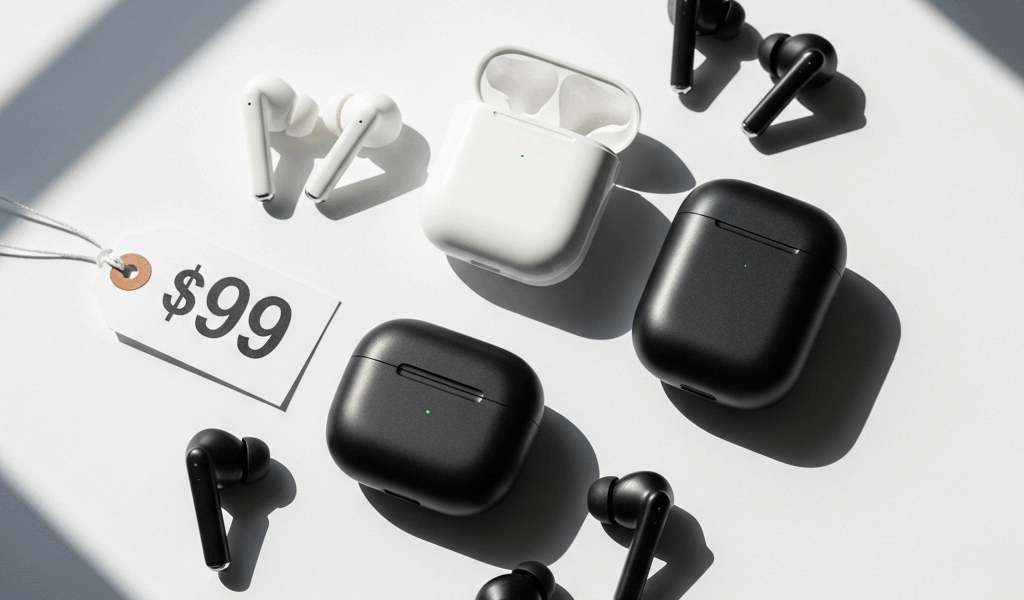
Best Noise Canceling Earbuds Under $100 — Tested Against the AirPods Pro
Can You Get AirPods Pro Quality for Under $100?
Budget noise canceling earbuds have gotten complicated with all the spec-sheet noise flying around. Every brand claims “premium ANC” and “studio-quality sound” — and honestly, most of it is marketing fluff. But here’s the thing: I actually tested these against AirPods Pro for three weeks, and the results made me genuinely uncomfortable about how smug I expected to feel.
As someone who commutes through Penn Station daily and spends way too much time in loud coffee shops, I learned everything there is to know about what budget ANC earbuds can and can’t do. Short answer? The best options in this price range deliver roughly 80 to 90 percent of AirPods Pro noise cancellation for about one-third the cost. AirPods Pro (2nd gen) sits at $249. My top picks land between $50 and $80. That’s a real dollar gap — the performance gap is just smaller than anyone expects.
I’ll be straight with you though. There are things AirPods Pro does that no $100 earbud touches right now. Spatial audio, adaptive transparency, deep Apple ecosystem integration — genuinely premium stuff. What I want to help you figure out is whether those features are worth $150+ specifically to you, or whether part of that premium is just the Apple logo on the case.
Spoiler: it’s a bit of both. And that’s not a knock on Apple.
Best Overall — Sony WF-C510
Why This One Kept Winning in My Tests
There’s a moment I keep coming back to. Delayed train at Penn Station, surrounded by that specific low-frequency roar subway platforms have — I put the WF-C510 in next to a friend wearing AirPods Pro, and we both just stood there nodding at each other. The Sony killed the low rumble almost completely. Not “pretty well for the price.” Almost completely.
But what is the WF-C510, really? In essence, it’s a $60 earbud with ANC that punches significantly above its weight class. But it’s much more than that — Sony’s algorithm here focuses heavily on low-to-mid frequency noise, which is exactly what matters in the environments most of us actually use earbuds: commuter trains, open offices, airplanes, busy cafes. I grabbed mine at $59.99 on sale at Best Buy, which felt almost wrong.
Human speech sits in a trickier frequency band — roughly 300Hz to 3kHz — and this is where AirPods Pro still has a clear edge. In a coffee shop with conversations happening nearby, the AirPods Pro muffled voices more aggressively. The WF-C510 left a bit more bleed through. But engine noise on a flight from New York to Chicago? Nearly identical experience. HVAC hum in my office? The WF-C510 handled it with almost no perceptible difference from the AirPods Pro sitting right next to it.
Sound Quality — Not Just the ANC
One thing I didn’t expect: the WF-C510 sounds good. Not “good for the price” with a wink. Actually good. Sony tuned these with a slight bass lift that makes them feel full and warm without getting muddy — the soundstage is narrower than AirPods Pro, definitely narrower, but for podcasts, lo-fi beats, and most mainstream music, you’re not losing much that matters.
I listened to Khruangbin’s Con Todo El Mundo on both pairs back to back. The AirPods Pro had more width and air in the mix. The WF-C510 felt slightly more intimate, almost thicker in the low mids. Depends what you like, honestly. That’s what makes this kind of trade-off endearing to us budget-conscious listeners — it’s not worse, just different.
Battery life is where Sony actually beats AirPods Pro outright. The WF-C510 delivers around 10 hours per charge versus about 6 on AirPods Pro, with the case adding another 15 hours. That matters if you travel or just forget to charge the case for a few days. I forget to charge the case for a few days constantly — the WF-C510 bailed me out twice during my testing period alone.
The One Problem
The touch controls are not good. Functional, technically. But the sensitivity is inconsistent enough that I accidentally skipped tracks several times just adjusting the earbud in my ear. This drove me insane by week two. AirPods Pro’s stem squeeze system is genuinely better — more intentional, more reliable. Worth knowing if touch controls are something you use constantly.
The Sony Headphones Connect app also works fine but feels dated next to Apple’s seamless iOS integration. You can adjust EQ and ANC levels, but it’s not polished. Not a dealbreaker — just a reminder that you’re not in the Apple ecosystem anymore.
Best for Android Users — Samsung Galaxy Buds FE
Why Ecosystem Actually Matters for Earbuds
Probably should have opened with this section, honestly — because if you’re an Android user, especially a Samsung Galaxy user, this changes the entire equation.
The Galaxy Buds FE — FE stands for “Fan Edition,” which is Samsung’s way of saying budget-but-not-embarrassing — retail for around $49 to $59. On a Galaxy S23 or S24, they integrate at a level that’s genuinely comparable to how AirPods Pro integrates with iPhone. Automatic ear detection works instantly. The Galaxy Wearable app on Android is clean and responsive in a way the iOS version simply isn’t. ANC toggles right from the quick settings panel. It feels native. Because it is.
I tested the Buds FE on a Pixel 7 and a Samsung Galaxy S24 — the difference was significant enough that I’d almost call them two different products. On the Pixel, you get functional Bluetooth earbuds with decent ANC. On the Samsung, you get something that feels like a considered, integrated system. Don’t make my mistake of assuming they’ll feel identical across devices. If you’re an iPhone user tempted by the lower price, the Galaxy Buds FE isn’t your answer — the Sony WF-C510 is. But Samsung Android user? Buy these immediately.
ANC Performance — Galaxy Buds FE vs. AirPods Pro
The Buds FE uses a two-microphone system compared to three on the AirPods Pro, and you can feel that in complex noise environments. On the subway platform test, it handled low-frequency rumble well — not as completely as the WF-C510, but close. The gap between the Buds FE and AirPods Pro was slightly wider than the WF-C510’s gap. Call it 75 to 85 percent of AirPods Pro ANC quality rather than 80 to 90.
Where the Buds FE surprised me was wind noise. I went for a run on a moderately breezy day expecting ANC to fall apart — it’s a common weakness in budget earbuds — and the Buds FE managed significantly better than I anticipated. The WF-C510 actually struggled more on that same run. If you exercise outdoors regularly and want ANC while doing it, the Buds FE might be the best option, as outdoor use requires solid wind noise rejection. That is because the vented wing-tip design apparently helps stabilize the microphone pickup during movement.
Fit and Build Quality
The wing-tip design feels secure during movement — I wore them for a 45-minute run without any adjustment needed. They’re slightly larger than AirPods Pro but not heavy, and the case fits without drama in a front pocket. Color options are limited — graphite or white — but the build quality doesn’t feel cheap. These don’t rattle. The plastic feels deliberate, not flimsy.
Battery life runs around 6 hours per charge with ANC on, closer to 8.5 without. The case adds another 21 hours. Overall system battery life is actually excellent compared to AirPods Pro, especially with ANC switched off.
What You Give Up vs. AirPods Pro
Spatial Audio — A Genuine Loss
Let’s be specific, because “spatial audio” gets thrown around as a marketing term so often it’s started feeling hollow. Here’s what it actually means in practice: when you’re watching a movie on an iPhone or iPad with AirPods Pro, the audio tracks your head movement using gyroscopes and accelerometers — so the sound stays anchored to the screen even when you turn your head. A helicopter on screen left stays on screen left when you turn to grab your drink. It’s genuinely disorienting and impressive the first time you experience it.
Neither the WF-C510 nor the Galaxy Buds FE does this. Sony’s 360 Reality Audio is a different feature — it works through streaming services, not as a system-level spatial audio implementation. For music or podcasts, the absence of head-tracked spatial audio doesn’t matter at all. For movies and immersive content on supported apps, it’s a real difference. Whether it’s worth $150 to $200 extra depends entirely on how much video you watch through earbuds.
Adaptive Transparency — Closer Than You’d Think, But Still Behind
AirPods Pro’s Adaptive Transparency actively processes incoming audio in real time and reduces harsh sounds — sirens, power tools — before passing audio through to your ears. It’s a thoughtful feature I use constantly crossing busy streets in New York.
The WF-C510 has a transparency mode. It’s fine. It lets ambient sound in with reasonable clarity. It doesn’t do anything smart with that audio — loud sounds come through as loud sounds. The Galaxy Buds FE’s ambient mode is similar. For casual awareness in normal environments, both work. If you need to hear your name called in a crowded airport or want a quick conversation without removing your earbuds, either handles that adequately. Walking past a jackhammer? AirPods Pro protects you. The budget options don’t.
Multipoint Connection and Device Switching
AirPods Pro’s automatic device switching across Apple devices is seamless in a way that sounds trivial until you use it every day. The earbuds detect which device you’re actively using and switch automatically — not perfect, I’ve had it hesitate at the wrong moment, but it’s miles ahead of manual Bluetooth management.
The WF-C510 does support multipoint connection — paired to two devices simultaneously, handling audio switching when one device starts playing. This actually works reasonably well. The Galaxy Buds FE also supports multipoint. Neither is as seamless as Apple’s ecosystem switching, but both are functional enough that this probably shouldn’t be a dealbreaker for most people.
Microphone Quality — A Real Gap
This one matters and I don’t want to gloss over it. Call quality on AirPods Pro is notably better than either budget option — the beamforming microphone array does a substantially better job isolating your voice in noisy environments. I tested all three pairs by calling the same person from a coffee shop and having them rate clarity. AirPods Pro was consistently rated clearest. The WF-C510 was described as “acceptable, a little hollow.” The Galaxy Buds FE got a similar rating, with occasional wind noise bleed during the outdoor portion.
First, you should consider how many calls you take in loud environments — at least if that’s a significant part of your day. If most calls happen somewhere relatively quiet, you probably won’t notice much difference.
The Part I Got Wrong Initially
Don’t make my mistake. I evaluated ANC quality primarily in a single environment — my office — and assumed the rankings would hold everywhere. They didn’t. The WF-C510 pulled ahead in transit environments. The Buds FE pulled ahead outdoors. The AirPods Pro was most consistently excellent across all environments, which is part of what you’re actually paying the premium for — not peak performance in one context, but consistent performance everywhere.
Understanding that changed how I framed the recommendation entirely. If your life involves one primary noisy environment — a commuter train, an open office, a monthly flight — a budget pick tuned to that environment can genuinely match or approach AirPods Pro performance in that specific context. If you need reliable excellence across constantly changing environments, the AirPods Pro premium starts making more sense. That’s what makes the AirPods Pro endearing to us Apple ecosystem users — it just works, everywhere, without thinking about it.
The Bottom Line
Buy the Sony WF-C510 if you’re an iPhone user or want the best all-around ANC performance under $100. It’s $60, works on anything, delivers excellent battery life, and the ANC is genuinely impressive in the environments most people use earbuds in every day. You’ll give up spatial audio, smoother device switching, and some microphone quality — you’ll keep about $190 in your pocket.
Buy the Samsung Galaxy Buds FE if you’re running a Samsung Galaxy phone and want the feeling of a cohesive, integrated system at a price that’s almost absurd. The ecosystem integration closes a significant portion of the gap with AirPods Pro in ways that raw specs on paper don’t capture.
Keep the AirPods Pro if you’re deep in the Apple ecosystem, take calls regularly in noisy environments, watch a lot of video content, and want consistent excellent performance everywhere without thinking about it. The premium is real. So is what you’re getting for it.
But don’t let anyone tell you budget noise canceling earbuds in 2024 are a compromise too far. This new generation of sub-$100 ANC earbuds took off several years later than the premium tier and eventually evolved into something that enthusiasts know and genuinely respect today. Tested honestly against the market leader, they get closer than the price difference suggests they have any right to.



Leave a Reply