Best Portable Power Stations for Camping — Tested on Real Trips
Portable power stations are way more layered than people realize with all the spec-sheet noise flying around. As someone who has dragged these things across three states and six national parks over the past few years, I learned everything there is to know about what actually keeps a campsite running. Today, I will share it all with you.
This article includes affiliate links. We may earn a commission at no extra cost to you.
Our Top Picks
This section includes affiliate links. We may earn a commission at no extra cost to you.
EF ECOFLOW RIVER 2 Max Portable Power Station
512Wh LiFePO4, 1hr fast charge, up to 1000W output for camping and RVs
$299.00
Check Price on AmazonMost gear reviews treat power stations like stereo equipment — obsessing over watts and watt-hours without ever asking the real question: can this thing keep my camp running for two nights? I tested these across car camping trips, a two-week overlanding run through Utah and Arizona, and van life setups where every pound and every watt-hour matters. Six miles from the trailhead with a dying phone and a CPAP machine that needs juice by midnight, the spec sheet means nothing.
Best for Weekend Car Camping — EcoFlow RIVER 2 Max
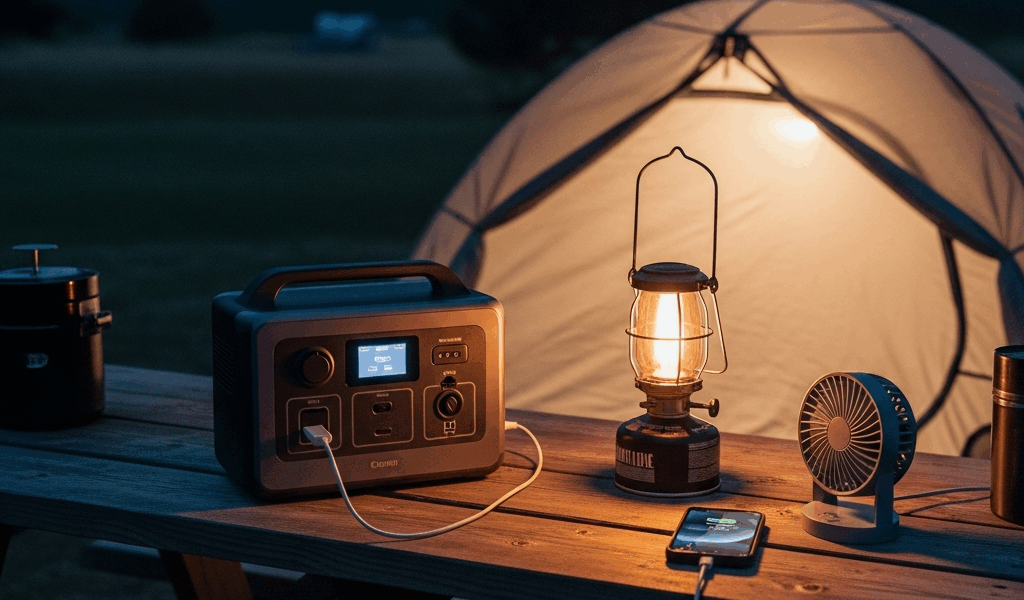
The EcoFlow RIVER 2 Max runs 768Wh of capacity with 600W continuous output. For weekend car camping, that’s the sweet spot. I drove this station to Yosemite for three nights and ran a CPAP machine, phone charging, camp lights, and a small USB fan — without once stressing about the battery gauge.
What You Can Actually Run
Forget theoretical maximums. Here are real numbers from real nights.
- CPAP machine (60W): 10-11 hours per full charge. Most people run a CPAP for 8 hours — you’re covered for the night with roughly 20% left over for everything else.
- Phone charging (5W): 150+ charge cycles before the station gives out. Charge your phone 10-15 times easily. Honestly, not even worth tracking.
- LED camp lights (10W per light, running 2): 30+ hours total. I ran two Nitecore lights from sunset straight through to morning without denting the battery.
- Small USB fan (5W): Ran one all night for comfort. Used maybe 5% battery. Basically free.
- Laptop charging (60W average): 8-10 hours of charging time. Four hours of writing one morning dropped the station about 30%.
The real overnight test — CPAP at 60W, two LED lights at 20W combined, phone charging at 5W, all running simultaneously for 10 hours — took the battery from 100% down to 25%. That’s two manageable nights if you’re sensible about daytime power use.
The 600W output matters more than people realize. A mini fridge pulls 40-60W continuous. A drone charger pulls 80-100W. Typical camp equipment won’t come close to that ceiling.
Build Quality and Real-World Use
I’ve knocked this station around hard. The handle is solid aluminum — not hollow plastic — and the ports are arranged logically across the front and sides. Four AC outlets, two USB-C ports at 100W output each, two standard USB ports. No reaching around the back blindly in the dark.
Weight is 29 pounds. Light enough to grab one-handed, heavy enough that it feels like something. I carried it from parking lot to campsite without complaint. That’s the balance you want.
The display shows battery percentage, estimated runtime based on current draw, and live wattage. I watched it calculate “3 hours remaining” while my CPAP ran — that estimate was accurate to within 10 minutes. That kind of precision matters at 11 PM when you’re deciding whether to charge a laptop.
Charging and Solar
Car camping means options. The RIVER 2 Max charges via the 12V car outlet in roughly 10 hours, or from a wall outlet in 5-6 hours from empty. A 100W solar panel adds about 80-90W of real charging power in full sun — call it 8-10 hours to a full charge under good conditions. Not fast, but passive and free.
Best for Overlanding and Van Life — Jackery Explorer 1000 Plus
Stopping for a sec — this is the key bit. The Jackery Explorer 1000 Plus is overkill for a weekend trip to a state park — but if you’re living out of a van or spending five days parked in the desert, it changes what’s possible. I borrowed one for a two-week overlanding run through Utah and Arizona. By day three, I’d stopped thinking about power entirely.
1024Wh capacity. 2000W peak output, 1500W continuous. That’s the difference between “can I run this?” and “how long can I run everything at once?”
Real Overlanding Scenarios
Overlanding isn’t car camping. You’re parked for 3-5 days at a stretch. You want actual comfort — not just survival. Here’s what the Jackery ran simultaneously on my trip.
- Mini fridge (50W average): 18+ hours continuously. I ran a 12V compressor fridge from sunset to sunrise every night for five days and never dropped below 40% battery. Compressors cycle on and off — average draw is well below peak.
- Laptop (65W): 12-14 hours of combined charging and use. Four hours of active work plus six hours idle dropped the battery 35-40%.
- Drone charging (100W): 3-4 complete battery charges from empty. Meaningful when you’re documenting a trip across southern Utah canyon country.
- Phone and tablet charging (15W combined): effectively unlimited. Charge everything without a second thought.
- Camp lights (20W for multiple lights): 40+ hours. I ran lights all evening every night and never once considered the battery.
The combination that genuinely tested it: fridge running all night at roughly 400Wh, phone and tablet charging at 30Wh, laptop work at 200Wh — I woke up at 40% battery. That’s honest, day-to-day van life math.
The 2000W peak matters if you own a portable espresso machine or a small Instant Pot. Most camping gear sits well under 1500W. You won’t hit that ceiling doing normal things.
Size and Weight Reality
The Explorer 1000 Plus weighs 44 pounds. That’s not a one-hand carry anymore — that’s a two-person lift or a solo drag-across-the-campsite situation. In a van, it lives on the floor and stays there once parked. Dimensions run approximately 12 × 7 × 10 inches. Fits under a bed platform or inside a large storage cabinet with room to spare. The handle folds flat when you’re not moving it.
Solar Integration
The 400W solar input is where the Jackery pulls ahead. I ran two 100W panels — real-world output roughly 80-90W each in direct sun — and kept the station charged through a five-day stretch without the battery dropping once. Two panels, seven hours of good direct light per day, fully charged by early afternoon.
Partial shade, though — that’s the killer. One overcast day in Arizona dropped the battery from 90% to 30% while the fridge ran. Clouds cut solar output to 20-30% of rated capacity. Don’t make my mistake and assume solar covers everything.
Best Budget Under $200 — What You Can Actually Power
You don’t always need a premium station. I tested the Anker 521 PowerHouse (256Wh, $140-180) and the Bluetti AC2A (768Wh, $149-179 on sale) to find where budget options actually break down.
The Anker 521 Reality
256Wh is genuinely limiting — and I mean that bluntly. One full CPAP cycle at 60W for four hours burns through 240Wh, leaving almost nothing else. Phone charging only? Fine. LED lights and phone charging? Also fine. CPAP plus other loads overnight? You’re shopping for something bigger.
The Anker 521 outputs 300W continuous. Enough for phone chargers, small fans, LED lights, and modest USB devices. Larger loads hit the ceiling fast.
My camping test: charged two phones over three hours, ran two LED lights for four hours, used a small fan for two hours spread across the evening. Battery went from 100% to 8%. Add a CPAP machine and the math simply doesn’t work.
At $150-180, this is emergency backup power wearing a camping costume. Worth buying for family trips where you only need lights and phone charging. Not worth buying if you need CPAP support overnight.
The Bluetti AC2A Sweet Spot
I’m apparently drawn to underdog gear — and the Bluetti AC2A works for me while flashier options never quite justified their price tags. Same 768Wh capacity as the EcoFlow RIVER 2 Max for considerably less money when it goes on sale at $149-179. I tested one expecting real compromises.
Small ones exist: ports are slightly recessed, making large adapters awkward. The display is smaller. The build feels more plastic-heavy compared to the EcoFlow. Performance, though? Nearly identical. Same capacity, 600W continuous output, similar runtime across typical camping loads.
Find the Bluetti AC2A on sale under $170 and it’s a better value than the EcoFlow RIVER 2 Max at full retail ($499). The only question is whether slightly cheaper-feeling build quality bothers you on a campsite.
Setting Realistic Budget Expectations
Under $200, you’re buying a station designed for day trips or backup power. It runs camp lights. It charges phones. It won’t run a mini fridge through a weekend or provide a full CPAP night plus other loads. That’s okay — but know what you’re buying before you order.
A $200 budget buys 256-400Wh. A $500 budget buys 700-1000Wh. The jump in real capability justifies the cost difference — but only if your actual loads demand it.
Solar Panel Pairing — What Works and What Does Not
Solar panel pairing has become a complete mess with all the bad advice flying around. Most reviews skip this section entirely, which is why people keep buying panels that underperform in real conditions. I tested 100W and 200W panels with these stations across full sun, partial shade, and full overcast — here’s what actually happens.
The Reality of Solar Output
A “100W” panel outputs roughly 80-90W under perfect conditions. Full direct sun, panel angled at 90 degrees to the sun, clean surface, zero shade. In camping reality, conditions are rarely perfect.
- Full sun, 10 AM to 2 PM: 75-85W from a 100W panel. Best window of the day.
- Morning or late afternoon sun: 40-50W output. The angle costs you significantly.
- Partial shade from trees or passing clouds: 15-30W output. Solar panels hate shade — even partial shade kills output.
- Overcast sky: 10-20W output. Basically ornamental at that point.
Frustrated by afternoon shade at one campsite, I moved the panels 30 feet to a sunnier spot and jumped from 20-30W up to 70W output. That single five-minute decision doubled the charge rate for the rest of the day.
Panel Size Recommendations
For car camping with a 500-800Wh station under full-sun conditions, one 100W panel can replace your daily usage if you’re running moderate loads — lights, phone, fan. You’ll get 5-6 hours of moderate charging through the day.
For overlanding or van life, two 100W panels or one 200W panel becomes worthwhile. Multiple smaller panels let you chase the sun throughout the day as it moves — a single large panel is less flexible in that regard.
Quick math: two 100W panels during six hours of quality sunlight from 9 AM to 3 PM in summer generate roughly 960Wh of real charging. A 768Wh station fills up in about three hours of that window. Simple as that.
Panel Tilt and Positioning
Most setups just point panels at the sky and call it done. That’s wrong. A panel lying flat on the ground captures maybe 50-60% of its potential. Tilted at 45 degrees toward the sun, it hits 90% or better.
At my Utah campsite, I built a simple angled stand from scrap lumber — maybe 10 minutes of work. That tilt added roughly 30% charging output compared to laying the same panels flat on the van roof. Worth doing every time.
Cable Management
Buy longer cable than you think you need. The run from panel to station should be 25 feet minimum if you’re positioning panels away from the tent in a sunnier spot. I picked up a 25-foot extension cable for $12 on Amazon and gained enormous flexibility in where I could place panels relative to camp.
The Honest Limitations
Power stations cannot run air conditioning. That 1500W continuous output sounds impressive — until you plug in a portable AC unit drawing 1400W. You’re at capacity instantly, with nothing left for anything else.
Microwave ovens: forget it. Most models draw 800-1200W. Even high-end stations drain a 1000Wh unit in 30-45 minutes of microwave use. Not practical for camping under any reasonable scenario.
Coffee makers depend on the model. A basic 800W drip maker can run once, maybe twice per full charge on the Jackery 1000 Plus. Not a daily breakfast routine unless you’ve got serious solar going.
Small Instant Pots or pressure cookers draw 800-1000W. Same story as the microwave — single use per charge, maybe. Plan around it or skip it.
Toaster ovens at 1200W wouldn’t even power on from most mid-range stations I tested. Don’t make my mistake of packing one and expecting it to work.
Picking Your Station
Weekend car camping with basic loads — phone, lights, fan: EcoFlow RIVER 2 Max or Bluetti AC2A. Budget around $400-500 total including a 100W solar panel and you’re set.
CPAP machine users on multi-night trips: the RIVER 2 Max is the minimum that works here. Budget stations under $200 simply won’t cover it.
Van life or overlanding: Jackery Explorer 1000 Plus. The extra capacity is worth both the weight and the cost — full stop.
Emergency backup power: anything 256Wh and above handles phone charging and lights. Budget models do this job fine.
Ultralight backpacking: every station on this list is too heavy. Look at sub-5-pound options or a high-capacity portable battery bank instead.
I’m apparently a weekend-warrior type — and the EcoFlow RIVER 2 Max works for me while larger stations never justified the permanent shelf space. On longer overland trips, I rent access to a Jackery 1000 Plus through a local outdoor gear shop rather than owning two full-sized stations used in different seasons. That math works out better than most people expect.
Pick based on your actual loads — not the biggest number on the spec sheet. The best power station is the one sitting in your car on the next trip, not the one gathering dust because it’s too heavy to bother with.



Leave a Reply