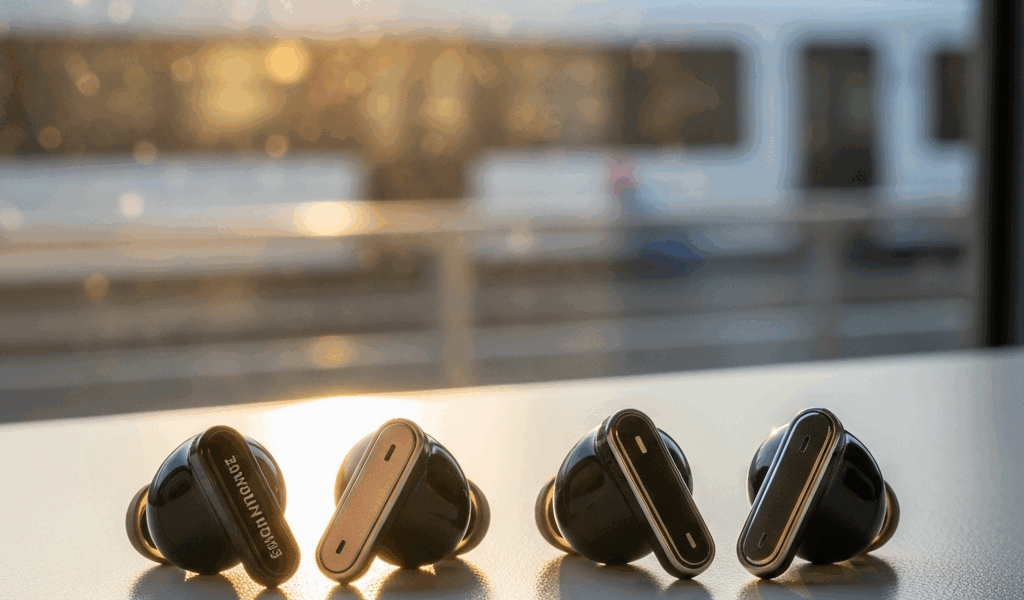
Quick Verdict — Which One Should You Buy
The AirPods Pro 2 vs Sony WF-1000XM5 debate has turned into an absolute tangle with all the spec-sheet noise flying around. So here’s the short answer before we get into anything else: iPhone user? Get the AirPods Pro 2. Android user, or someone who logs serious hours on planes and trains? The Sony WF-1000XM5 is your pick. That’s genuinely it. Everything below explains the reasoning — with a clear winner called in each category — so you’re not left squinting at an LDAC support footnote wondering what it means for your Tuesday morning commute.
This article includes affiliate links. We may earn a commission at no extra cost to you.
Our Top Picks
This section includes affiliate links. We may earn a commission at no extra cost to you.
Apple AirPods Pro (2nd Generation) USB-C
H2 chip with adaptive ANC, personalized spatial audio, four tip sizes including XS, MagSafe USB-C case
$249
Check Price on AmazonIndustry-leading ANC with 8-microphone system, LDAC codec, and 8-hour single-charge battery
$299
Check Price on AmazonAs someone who has been swapping between both pairs daily for several months, I learned everything there is to know about where each one earns its price tag. The AirPods Pro 2 — second generation, dropped October 2022, retails around $249. The Sony WF-1000XM5 — released July 2023, running $279–$299 depending on where you buy. Commutes, gym sessions, back-to-back Zoom calls, long work blocks. Today, I will share it all with you.
| Use Case | Winner |
|---|---|
| Noise cancellation | Sony WF-1000XM5 |
| Call quality | AirPods Pro 2 |
| Transparency mode | AirPods Pro 2 |
| Workout fit | AirPods Pro 2 |
| Battery life | Sony WF-1000XM5 |
| iPhone ecosystem | AirPods Pro 2 |
| Android ecosystem | Sony WF-1000XM5 |
Noise Cancellation — Sony Still Leads Here
Sony wins. Not by a mile — but by enough that it actually matters in the environments where ANC earns its keep.
Stand on a subway platform while a six-car train rolls in at somewhere around 95 dB, and the difference stops being theoretical. The WF-1000XM5 digs into low-frequency rumble in a way that feels almost physical — engine drone, office HVAC systems, the deep bass hum of a long-haul flight cabin. The XM5s seem to pressurize around that frequency range. Apple’s ANC is genuinely excellent, better than most things on the market, but Sony has spent years obsessing over this one specific problem and it shows.
Frustrated by patchy ANC performance from a previous pair, I started paying close attention to how both earbuds handled my morning commute on the London Overground — rattling carriages, loud conversations, the full experience. The Sony left me more isolated, consistently. With the AirPods, sharp high-frequency sounds still occasionally cut through — a door beep, someone raising their voice two seats over. The Sony muffled more of it.
Open-plan offices tell the same story. Low AC hum, ambient chatter — Sony handles it better. If blocking out the world during focused work or long travel is the main job, the WF-1000XM5 is the correct tool. That’s what makes the XM5 endearing to us frequent travelers and deep-focus workers.
Winner — Sony WF-1000XM5
Call Quality and Transparency Mode
Pausing for the bit that actually matters. For a lot of people — remote workers doing back-to-back calls especially — this is what actually decides it.
AirPods Pro 2 win here. It’s not close.
Apple’s six-microphone system with adaptive beamforming does something genuinely impressive on calls — it isolates your voice and suppresses background noise without making you sound processed or far away. I’ve had people on Zoom tell me I sounded cleaner through the AirPods than through my laptop’s built-in mic. A 13-inch MacBook Pro mic. That’s not a compliment you stumble into.
Sony’s mics on the WF-1000XM5 are capable — noticeably improved over the XM4s, for the record. But there’s a slight processed quality to how your voice comes through, particularly in wind or noisier environments. Not bad. Just not Apple-level.
Transparency mode tells the same story. Apple’s “Adaptive Transparency” earns the name — walking down a busy street with it on feels almost eerily natural, like the earbuds aren’t there. Voices come through warm. Sony’s transparency mode is good but carries a mild thinness, a subtle reminder that you’re listening through a microphone rather than just hearing the world.
Regular calls, audio recording, or just wanting to stay aware of your surroundings without yanking an earbud out — AirPods Pro 2 are the better tool. Full stop.
Winner — AirPods Pro 2
Fit Comfort and Workout Use
Both carry an IPX4 sweat and splash rating. That part’s a draw. The fit question is more interesting.
The AirPods Pro 2 added an extra-small (XS) tip to the existing S, M, and L lineup — four total sizes now — and it made a real difference for people who always found Apple’s in-ear designs slightly too bulky. The housing sits close to the ear, minimal protrusion. During runs, HIIT sessions, anything involving real head movement, they stay put. The silicone tips grip without becoming uncomfortable after an hour.
The Sony WF-1000XM5 are physically larger. The housing is more substantial — 5.9 grams per earbud versus the AirPods Pro 2 at roughly 5.3 grams. That 0.6-gram difference sounds trivial. It isn’t. During interval training I noticed the Sony units shifting, requiring a press-back-in that broke rhythm. On a long run, one earbud worked slightly loose around the 40-minute mark. Not a disaster — just a nagging adjustment issue you shouldn’t have to deal with at $279.
Don’t make my mistake of assuming the weight difference wouldn’t matter. It does, specifically during movement.
For stationary listening — desk setup, plane seat, coffee shop — the Sony’s more substantial fit actually feels stable and comfortable for hours. Long listening sessions on the XM5 feel genuinely fine. They’re not uncomfortable; just not optimized for movement.
- Gym and running — AirPods Pro 2
- Long seated listening sessions — either, slight Sony edge for ANC benefit
- Universal fit across ear shapes — AirPods Pro 2, four tip sizes including XS
Winner — AirPods Pro 2 for workouts; personal preference for stationary use
Battery Life and Ecosystem Lock-In
Sony wins the raw battery numbers. The WF-1000XM5 delivers around 8 hours on-ear with ANC running, plus another 16 from the case — 24 hours total. AirPods Pro 2 land at about 6 hours on-ear, though the MagSafe case pushes the total to 30 hours. For marathon travel days where you’re not near an outlet, Sony has the edge in a single uninterrupted sitting.
But the ecosystem question is the real deciding factor — and honestly, I underestimated it before testing both pairs seriously. Don’t make my mistake here either.
AirPods Pro 2 on an iPhone aren’t just earbuds. They’re an extension of iOS. Audio switches automatically between your iPhone, iPad, and Mac without any input from you. Move from your phone to your laptop — the audio follows. Find My integration puts a lost earbud on the same map as your iPhone. Siri responds hands-free without pressing anything. First-time setup takes about fifteen seconds. Firmware updates install silently through iOS. You never think about any of it.
Android users get almost none of that. The Sony Headphones Connect app on Android is genuinely well-built — better than most companion apps at this price — with solid EQ customization, ANC adjustment, and speak-to-chat configuration. Sony has invested in making their earbuds work well across ecosystems rather than building walls around one. That’s what makes the XM5 endearing to us Android users who’ve been burned by walled-garden accessories before.
I’m apparently an iPhone-first person and the AirPods ecosystem works for me while manual Bluetooth switching never quite did. The friction accumulated — no Find My, slightly clunkier pairing, no seamless device handoff. Small things individually. They add up fast.
Final Who-Should-Buy-What Summary
Buy the AirPods Pro 2 if you’re on iPhone, take regular calls, work out consistently, or want a transparency mode that doesn’t sound like you’re listening through a tin can. At $249, they’re the stronger all-rounder for Apple users — and the call quality alone justifies the price for remote workers doing back-to-back video calls.
Buy the Sony WF-1000XM5 if you’re on Android, travel frequently and need maximum ANC against low-frequency noise, or battery stamina matters more to you than ecosystem features. At $279–$299, you’re paying a small premium for noise cancellation Apple hasn’t fully matched yet. Worth it for the right use case.
Neither is a bad call. But one of them is right for you — and now you know which one. So, go buy it.

Leave a Reply