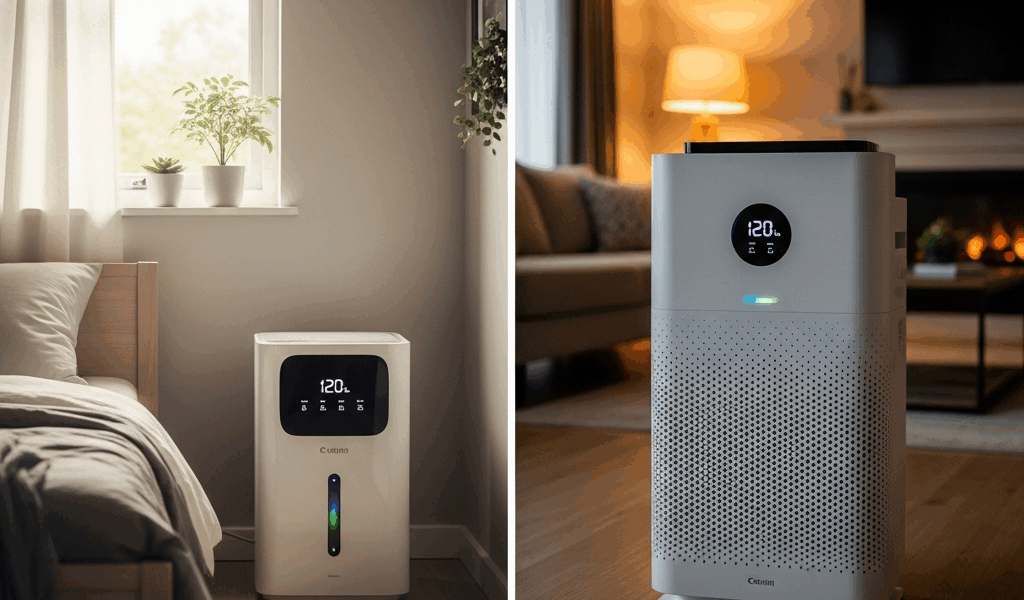
Levoit Core 300 vs Winix 5500-2 — Which Air Purifier Wins
The 5-Second Verdict
Air purifier shopping has gotten complicated with all the spec-sheet noise flying around. So let me cut straight to it. Room under 220 square feet — a small bedroom, a nursery, a cramped home office — get the Levoit Core 300. Done. Costs less, handles the space, and you’re not throwing money at capacity you’ll never use. Room between 220 and 360 square feet? Winix 5500-2, full stop. Above 360 square feet? Close this tab and go look at the Coway AP-1512HH Mighty or something with a higher CADR rating, because neither of these two will actually clean that room. They’ll just run constantly and make you feel like they’re doing something.
That’s the whole framework. Everything below is just the math behind it.
Room Size and CADR — The Real Number That Matters
But what is CADR? In essence, it’s Clean Air Delivery Rate — a measurement of how many cubic feet of filtered air a purifier moves per minute. But it’s much more than that. It’s really the only spec worth caring about. Not the unit’s physical size. Not how many “stages” of filtration the box brags about. Just: how much clean air does it actually push?
Here are the numbers. Levoit Core 300: 141 CFM, manufacturer-rated for 219 square feet. Winix 5500-2: 232 CFM, rated for 360 square feet. The Winix delivers roughly 65 percent more cleaning power. That’s not a rounding error. That’s a different product category.
Confused by CADR when I first bought an air purifier, I made the mistake of choosing based on sticker price alone — put a small unit in my 280-square-foot living room, paid $89 for it, and felt pretty clever. Then allergy season hit. The thing ran on high constantly, my eyes still itched every morning, and the room smelled stale in a way I couldn’t shake. Returned it three weeks later. Don’t make my mistake. Match the CADR to the room first. Everything else is secondary.
Here’s the part most comparison articles skip entirely. A lower CADR isn’t automatically bad. In a 150-square-foot bedroom, the Levoit Core 300’s 141 CFM is doing its job correctly — cycling the air roughly five times per hour, which is exactly the target. Dropping a Winix into that same small room doesn’t make the air cleaner. It just runs louder and costs more money upfront and every time a filter needs replacing.
The mistake buyers make runs in both directions — Winix in a tiny room is overkill and unnecessary noise, and a Levoit Core 300 in a 300-square-foot living room is a unit that will never fully turn over the air volume no matter how long it runs. Match the unit to the room. That’s it.
- Under 220 sq ft — Levoit Core 300 is sufficient
- 220–360 sq ft — Winix 5500-2 is the right fit
- 360+ sq ft — look elsewhere (Coway Mighty, Winix AM90, or Blueair options)
Filtration Comparison — What’s Actually Inside
Probably should have opened with this section, honestly, because the PlasmaWave question is what fills every comment section on every Winix review thread ever written.
Both units run a 3-stage setup: pre-filter for large particles, a true HEPA layer catching particles down to 0.3 microns, and an activated carbon filter for odors and VOCs. At the mechanical filtration level, they’re essentially comparable. Neither has a meaningful edge there.
The Winix 5500-2 adds PlasmaWave technology — an ionizer that generates hydroxyls to break down pollutants at the molecular level. Sounds great on paper. The catch is that PlasmaWave produces a small amount of ozone as a byproduct. The EPA has reviewed units like this and found ozone output below harmful thresholds under normal use, so it’s not a five-alarm situation. But ozone is a lung irritant. If you have asthma, chemical sensitivities, or you’re buying this for a child’s room — that’s a real consideration, not a hypothetical one.
The Winix includes a dedicated button to disable PlasmaWave entirely. Run it as a straight HEPA-plus-carbon purifier with zero ionization. A lot of owners leave PlasmaWave off permanently — which means they’re paying for a feature they never touch. Worth knowing going in.
The Levoit Core 300 has no PlasmaWave. Nothing to disable. No ozone concern, no button to remember, no feature requiring explanation to a worried partner at 11 PM. I’m apparently sensitive to ionizer-style products and the Levoit setup works for me while ionizers never quite sit right. For anyone wanting to eliminate that variable entirely, the Core 300’s simplicity is honestly a genuine selling point.
Noise Levels — Sleep Test
Both units measure around 40–41 dBA on their lowest settings. For context, a quiet library sits at roughly 40 dBA. At sleep mode, both produce a soft, consistent white noise — the kind most people find easy to sleep through, and that some sleepers actually prefer over total silence.
At maximum fan speed, the Winix 5500-2 hits 66.4 dBA. The Levoit Core 300 tops out at 64.9 dBA. That 1.5-decibel gap at max speed is technically measurable and practically imperceptible — both land around the volume of a normal conversation.
Here’s what actually matters for bedroom buyers. You will almost never run either unit at maximum speed overnight. That’s just not how bedroom purifiers get used. You set it to low before bed. It sits there quietly for eight hours. The max-speed specs that dominate comparison tables are mostly useful for daytime operation in a room you’re not sitting in — so don’t let someone sell you a unit based on those numbers if overnight bedroom use is your primary goal.
Both of these pass the sleep test at their low settings. That’s the answer.
Filter Replacement Cost — Real Math
Running costs matter more than the sticker price over a 3-year ownership window. So let’s actually do the math.
Levoit Core 300 replacement filter sets run about $25. Levoit recommends swapping them every 6–8 months depending on air quality and runtime. Call it two per year conservatively. That’s roughly $50 annually — closer to $40 if your air quality is decent and you stretch each filter to 8 months.
Winix 5500-2 replacement filter sets — the HEPA and carbon combo — run around $50. Winix recommends annual replacement, and the unit ships with a washable AOC carbon pre-filter you rinse and reuse. That pre-filter handles some of the load, which means many owners comfortably push 14 to 18 months before replacing the main filter. Annual cost ends up closer to $35–40 in practice.
Bottom line: real-world annual filter costs for both units land within about $10–15 of each other. Don’t let filter pricing be your deciding factor. It won’t move the needle enough to matter.
Smart Features — Auto Mode and Air Quality Sensors
The Winix 5500-2 includes a built-in air quality sensor with a color indicator ring — blue for clean, amber for moderate, red for poor — plus an auto mode that adjusts fan speed based on what it’s actually detecting. You walk away, forget about it, and the unit ramps up when it picks up smoke, dust, or elevated particulates, then quiets back down when the air clears. If you cook a lot, have pets, or deal with wildfire smoke drifting in seasonally, that auto mode has genuine day-to-day value.
The base Levoit Core 300 has none of that. No sensor, no auto mode, no indicator ring. You pick a fan speed and it runs there until you change it manually. For a set-it-and-forget-it user running low speed overnight, that’s completely fine — the absence of sensors doesn’t hurt performance in a well-matched room.
There is an upgrade path worth flagging. The Levoit Core 300S adds Wi-Fi, app control, and scheduling for roughly $30 more than the base model. Still no built-in air quality sensor, though. If real-time auto mode is a feature you actually want, the Winix has a genuine advantage the 300S doesn’t close.
Price Check Today
The Levoit Core 300 typically runs $90–110 depending on where and when you buy. Amazon fluctuates, but it rarely drops below $85 or climbs above $115 for the base model.
The Winix 5500-2 typically lands at $159–189. It goes on sale a few times per year — Costco and Amazon both discount it periodically — and timing it right can get you close to $140.
That $60–80 gap is real money. For a small-bedroom buyer, that difference covers roughly 18 months of Levoit replacement filters. Paying a premium for CADR your room can’t use isn’t smart buying. For the buyer with a larger room, though, the Winix’s coverage capacity genuinely justifies the upcharge — you’d be properly sizing the unit instead of running an underpowered $100 purifier that never quite does the job.
What About the New Levoit Vital 100S
One thing worth flagging if you’ve been doing broader research. Levoit’s newer Vital 100S targets the 300–400 square foot segment — the exact zone where the Winix 5500-2 currently dominates this comparison. The Vital 100S posts a CADR of 251 CFM and typically sells for around $189, putting it in direct price competition with the Winix.
If your room falls in that 300–360 square foot range, the honest comparison to make is Levoit Vital 100S versus Winix 5500-2 — not Core 300 versus Winix. The Core 300 is simply not built for that room size, and pretending otherwise means buying the wrong unit twice. That’s a more expensive mistake than most people account for upfront.
So without further ado, here’s where it lands: small room, go Levoit Core 300. Medium-to-large room, go Winix 5500-2. Everything else is detail.


Leave a Reply