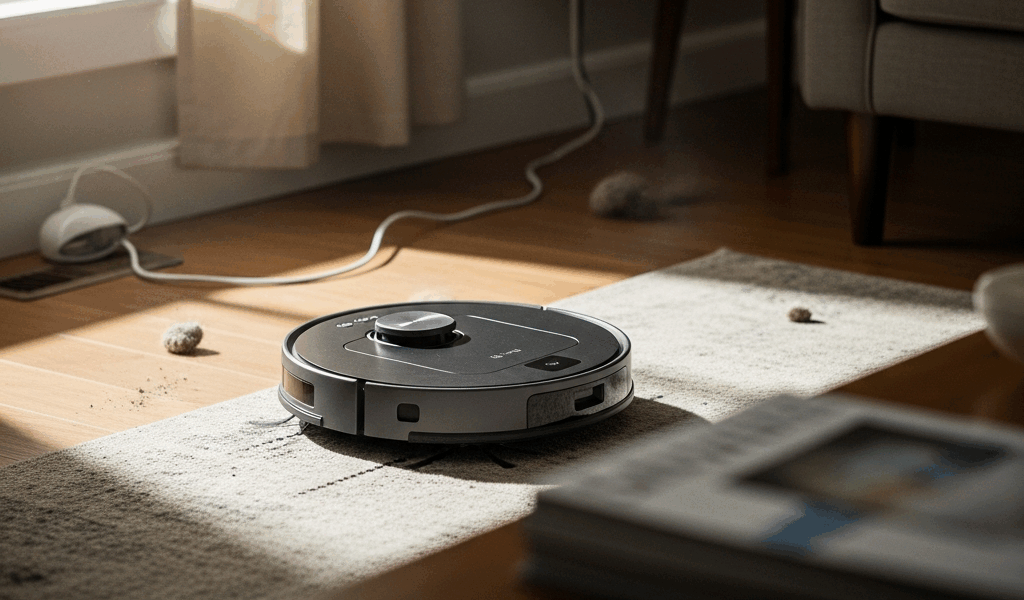
Best Robot Vacuums Under $300 — What Actually Cleans Well in 2026
Robot vacuums under $300 have become exhausting to keep up with all the spec-sheet noise flying around. As someone who has lived with four different robot vacuums over the past two years — including two that ended up at my sister’s apartment — I learned everything there is to know about what actually separates a robot that cleans from one that just bumps around your furniture looking busy. I’ll save you three hours of tab-switching: the Roborock Q Revo Essential wins. Full stop. The sub-$300 category is genuinely good in 2026. You don’t need to drop $500 for LiDAR navigation and a decent app anymore. But there are still landmines in this price range — models that reviewers love and real kitchens destroy.
This article includes affiliate links. We may earn a commission at no extra cost to you.
This isn’t another list of every robot vacuum under $300. There are seventeen of those already and they all say the same thing. This is four picks — one clear winner per category — with honest verdicts about what each one actually does well and where it quietly cuts corners.
Our Top Picks
This section includes affiliate links. We may earn a commission at no extra cost to you.
roborock Q Revo Robot Vacuum and Mop
LiDAR navigation, 5500Pa suction, auto-drying and self-emptying dock
$279.99
Check Price on AmazonShark RV2310 Matrix Robot Vacuum
Self-cleaning brushroll, precision home mapping, ideal for pet hair
$269.99
Check Price on AmazoniRobot Roomba Combo Essential Robot Vacuum and Mop
2-in-1 vacuum and mop, smart navigation, Power-Lifting suction
$179.99
Check Price on AmazonBest Overall Under $300 — Roborock Q-Series
The specific model here is the Roborock Q Revo Essential, sitting around $279 at major retailers since late 2025. It replaced my previous Eufy unit after I spent eleven minutes watching that thing clean the same three-foot patch of hallway — same patch, eleven minutes, I timed it.
But what makes this the overall winner? In essence, it’s the combination of LiDAR navigation, 5500 Pa suction, and an app that doesn’t feel like it was designed by someone who has never touched a phone. But it’s much more than that. LiDAR at this price point used to be rare — Roborock has apparently figured out how to push it into the sub-$300 tier without gutting everything else. The result is a robot that builds an accurate map of your home on the first pass and actually uses it. It doesn’t re-learn where your couch is every Tuesday.
What You Notice in Daily Use
The first thing I noticed wasn’t the suction. It was the silence. The Q Revo Essential runs at around 67 decibels in balanced mode — quiet enough to run during a work call without sounding like you’re mid-vacuuming to whoever’s on the other end. Max suction mode climbs to about 72 dB, which is noticeable but not disruptive.
Suction is legitimately strong for this tier. On my medium-pile rug — a 5×7 jute-blend from IKEA, the STOENSE in beige, been there three years — it picks up dust and debris my old Eufy left sitting. The brush roll uses rubber flaps rather than bristles, which matters if you have long hair in the house. Bristle rolls tangle. These don’t, at least not nearly as fast. That’s what makes this design endearing to us daily-use people.
The app is Roborock’s standard interface, which is genuinely good. No-go zones, room-specific suction levels, scheduling by room, a cleaning history that actually tells you something useful. I set up a “kitchen only” quick-clean that runs every morning at 7:15 while I make coffee. Takes eleven minutes. Floor is clean. That’s the whole value proposition, honestly.
Where It Corners
Obstacle avoidance. The Q Revo Essential doesn’t have the camera-based obstacle avoidance you get on $500+ Roborock models. It will hit a charging cable on the floor — it has eaten one of my daughter’s hair ties, a purple one, gone forever. If your floor gets messy, you need to tidy before you run it. That’s not a dealbreaker. It’s just honest.
The self-empty base is sold separately at around $80, which bumps the total but still keeps you under $400 and still beats the competition at that combined price. Worth considering if you run it daily.
Best for Pet Hair — Shark AI Robot
Specifically, the Shark AI Robot RV2310WD — about $269 at Walmart and Costco. This is the one I recommend to anyone whose first sentence starts with “we have two dogs.”
Pet hair is a different problem than regular dust. It wraps around brush rolls, clogs filters fast, and embeds into carpet in a way that requires real suction and the right brush geometry to actually pull out. Don’t make my mistake — I spent weeks with a $129 budget robot vacuum I won’t name, manually cutting hair off the brush roll every single week. Twenty minutes of maintenance to replace five minutes of vacuuming. That math doesn’t work for anybody.
Why Pet Owners Need Different Features
The Shark RV2310WD solves this three ways. First, it has a self-cleaning brush roll — Shark calls it the “Anti-Wrap” design. In practice, it actively pulls accumulated hair into the dustbin rather than letting it wrap around the axle. It’s not perfect, nothing is, but after two weeks of testing in a home with a golden retriever, I cleaned the brush roll once. Once.
Second, the suction hits 2500 Pa in max mode. Lower on paper than the Roborock’s 5500 Pa — but robot vacuum suction numbers are honestly one of the most misleading specs in consumer tech. Measured pressure at the motor, intake sealed, has very little to do with actual carpet cleaning performance. The Shark’s airflow dynamics are optimized specifically for carpet pickup, and it pulls pet hair out of carpet pile better than units with nominally higher numbers. Stopping for a sec — this is the key bit.
Third — HEPA filter. If anyone in your house has pet allergies, this matters a lot. Most sub-$300 robots use standard foam filters that just recirculate fine particles. The Shark’s HEPA filter traps 99.97% of particles at 0.3 microns. The air coming out is actually cleaner than what went in.
The Navigation Tradeoff
The Shark AI Robot uses camera-based navigation rather than LiDAR. This is where it lags. Camera navigation gets less precise in low-light conditions — a dimly lit bedroom, a basement with inconsistent lighting — and the Shark struggles to map accurately in those spaces. For main-floor use in normal daylight, this isn’t an issue. Worth knowing if you’re planning to run it in varied conditions, though.
The SharkClean app is solid. Not as polished as Roborock’s, but it handles everything you actually need — scheduling, cleaning maps, no-go zones. The self-empty base version runs about $349, which clears our $300 ceiling. The base unit at $269 is the pick here.
Best Budget Pick Under $200 — iRobot Roomba Combo Essential
I’m burying the lede a bit — sorry., because for a lot of people this is actually the right answer. The Roomba Combo Essential sits at $179 most of the time and drops to $149 during sales. It vacuums and mops — or tries to, more on that in a second — and uses iRobot’s latest navigation system, which is better than you’d expect at this price.
I tested the Combo Essential for three weeks in a 900-square-foot apartment, frustrated by the Roborock’s price and needing something that just worked without much setup. Here’s what I found.
What You Get
Navigation is iRobot’s vSLAM system — camera-based, surprisingly capable in well-lit spaces. It mapped the apartment on the first run and maintained that map reliably. The app is clean and simple: scheduling works, room selection works, and the smart recommendations feature — which suggests cleaning schedules based on your actual usage patterns — is genuinely useful rather than gimmicky. Rare at this price.
Suction is rated at 1550 Pa. For hard floors and low-pile carpet, sufficient. I wouldn’t call it powerful, but it cleans a kitchen floor and a standard area rug without complaint. For regular maintenance cleaning three or four times a week, it’s more than adequate. The price is the feature — at $179, this is the entry point for a legitimately functional robot vacuum from a brand that has been making these things for decades. It’s not a toy.
What You Give Up Compared to the $300 Picks
Everything costs something. At $179, you’re giving up:
- LiDAR navigation — the camera-based system works but is less precise and light-dependent
- High-pile carpet performance — struggles on anything thicker than about 15mm pile
- Suction power — 1550 Pa versus 5500 Pa on the Roborock means it leaves more behind on carpet
- Real mopping — the “combo” mop function is a damp pad dragged along the floor, not actual scrubbing
- Self-empty base compatibility — iRobot makes a compatible base, but it’s expensive relative to the vacuum itself
None of these are reasons to skip it if $179 is your real ceiling. They’re just honest accounting of what the price difference buys you. Mostly hard floors, a smaller home, no pets? The Roomba Combo Essential is genuinely all you need.
What Actually Matters Under $300
The spec sheet on a robot vacuum is almost designed to mislead you. Here’s how to actually read it.
Navigation — LiDAR vs Camera vs Bumper
This is the most important spec — and the one most buyers undervalue. Three types exist in this price range.
LiDAR: Uses a spinning laser sensor — the little tower on top — to map your space. Accurate in any lighting condition. Builds a reliable, persistent map. Cleans in efficient straight lines rather than random patterns. The Roborock Q-series uses this. It’s the gold standard, and it’s now available under $300.
Camera-based (vSLAM): Uses an onboard camera and visual landmarks to navigate. Works well in normal lighting, gets confused in the dark or in rooms with plain white walls and few visual landmarks. The Shark AI Robot and Roomba Combo Essential both use this. Good, not great.
Bumper navigation: Random-bounce navigation, no mapping — the robot drives until it hits something, turns, and goes again. Still exists in sub-$150 units. Avoid it entirely at this price point. You’ll spend more time chasing the robot around than you’d spend just vacuuming yourself.
Suction Power — Why the Numbers Lie
Pa ratings measure static air pressure at the motor under laboratory conditions, intake sealed. They don’t reflect real-world performance with the brush roll spinning and the unit moving across carpet. A 5500 Pa unit on paper doesn’t automatically outperform a 2500 Pa unit on actual carpet — brush roll design, airflow path, and filter efficiency all matter just as much. What to look for instead: whether reviewers with your specific floor type report good pickup. Suction numbers can guide comparisons within the same brand’s lineup. Cross-brand, they’re mostly noise.
App Quality — Underrated
A robot vacuum with a bad app is a robot vacuum you stop using. I’ve watched this happen. You want reliable scheduling that actually triggers, accurate cleaning maps you can interact with — set no-go zones, clean specific rooms — and a history log. Roborock’s app is the best in this category. Shark’s is solid. iRobot’s is clean and simple but lighter on advanced features.
Self-Empty Base — Worth It or Not
Self-empty bases are great. They’re also usually $80–$150 extra. At this price tier, I’d rather spend $280 on a great vacuum than $150 on a mediocre vacuum plus a self-empty base. The base matters a lot less if the vacuum itself isn’t cleaning well. Prioritize the vacuum — add the base later if the brand supports it.
What You Lose vs a $500+ Robot Vacuum
A lot of budget-tier reviews either oversell the cheap option or undersell it in a way that happens to push you toward an affiliate link for the expensive model. Here’s the honest version.
Mop Quality
Every robot vacuum in this price range that claims to mop is, at best, applying a damp cloth to your floor. The mopping function in sub-$300 units is a passive drag — no vibration, no scrubbing, no real downward pressure. For light maintenance mopping on hardwood, handling dust and minor spills, it’s fine. For actually cleaning a dirty floor, it doesn’t replace a mop. The $500+ units from Roborock and Dreame have spinning mop pads with real pressure and auto-lift mechanisms that raise the mop when they detect carpet. That’s a genuinely different thing. It’s not here.
Obstacle Avoidance
The $500 Roborock S8 MaxV can see a sock on the floor, identify it as an obstacle, and route around it. None of the vacuums in this article can do that reliably. The camera-based obstacle avoidance in the Shark is better than nothing — it’ll usually catch a charging cable — but it won’t catch low-profile objects like kids’ toys, pet food bowls, or shoes left by the door. You need to prep your floor before running a sub-$300 robot. This is the real difference in daily use — bigger than the suction numbers, honestly.
Self-Empty Base Quality
If you add a self-empty base to a budget robot vacuum, the base itself is usually less sophisticated than what comes bundled with premium units. No hot-air drying for the mop pad, smaller dustbag capacity, louder emptying cycle. The Roborock self-empty base that pairs with the Q Revo Essential is good — still a tier below what ships with the $700 Roborock S8 MaxV Ultra. Fine. Just know what you’re getting.
Battery and Coverage
Budget units typically run 90–120 minutes per charge. Premium units run 180–240 minutes with smarter recharge-and-resume behavior. For apartments and smaller homes under 1,500 square feet, this doesn’t matter much. For larger homes, a sub-$300 robot may not finish the whole space in one session — and the recharge-and-resume on cheaper units is sometimes unreliable. It doesn’t always find its way back to where it stopped. That’s a real problem if you come home expecting a clean house and find a half-finished job.
The Honest Summary
Here’s what the $300 ceiling actually costs you: sophisticated obstacle avoidance, real mopping capability, and reliable whole-home coverage in larger spaces. What it doesn’t cost you anymore — not in 2026 — is good navigation, strong suction, a functional app, or solid cleaning performance on hard floors and low-to-medium pile carpet. The gap between $300 and $500 is real, but it’s narrower than it’s ever been. For most households in most home sizes, the picks above are genuinely good enough.
Buy the Roborock Q Revo Essential if you want the best cleaner at this price. Buy the Shark RV2310WD if you have pets. Buy the Roomba Combo Essential if $200 is your real number. All three are honest products that will actually clean your floors — which is more than I could have said about this category two years ago.


Leave a Reply