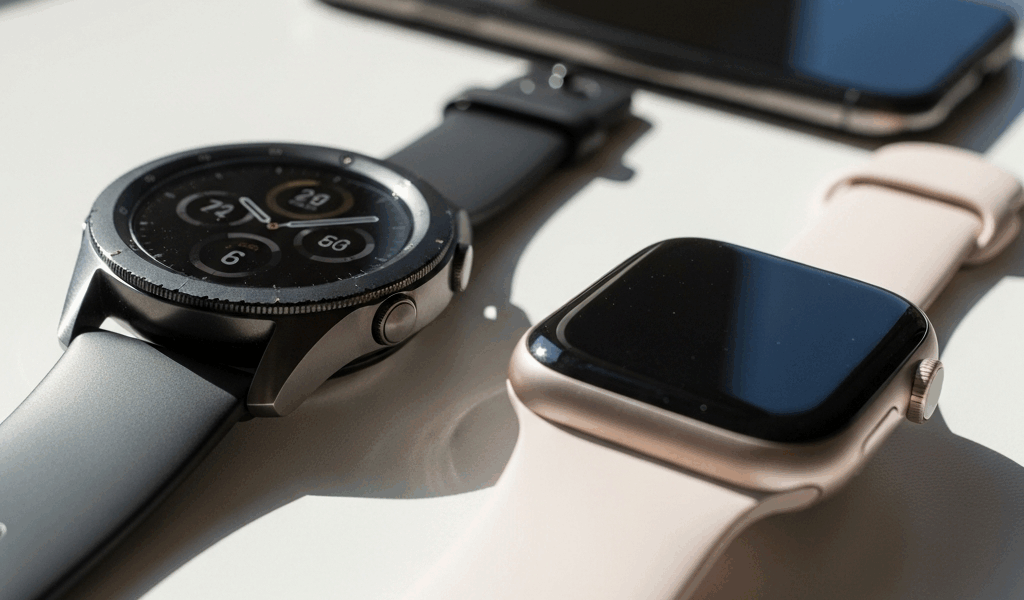
Samsung Galaxy Watch 7 vs Apple Watch Series 10
The Ecosystem Problem Nobody Warns You About
Smartwatch shopping has turned into an absolute tangle with all the spec comparisons and “best of” listicles flying around. As someone who wore both the Galaxy Watch 7 and Apple Watch Series 10 simultaneously for two weeks straight — during runs, desk work, and overnight sleep tracking — I learned everything there is to know about what actually separates these two. Today, I will share it all with you.
But first, the thing every comparison article buries: Apple Watch Series 10 only works with an iPhone. Full stop. No Android support, no workarounds, no “limited functionality” mode. Worth saying out loud before I go further. If you don’t own an iPhone, the Apple Watch Series 10 simply isn’t an option — end of discussion.
The Galaxy Watch 7 is more flexible — it pairs with most Android phones running Android 10.0 or later with at least 1.5GB of RAM. That said, it works best with Samsung Galaxy phones. Running a Pixel 8 or OnePlus 12? You’ll lose features like automatic workout detection and certain health dashboard integrations that Samsung Galaxy owners get straight out of the box.
So iPhone user? Buy the Apple Watch. Done. The rest of this is for the edge cases: Android users curious about Apple’s ecosystem, Samsung users genuinely on the fence, and iPhone owners considering a switch who want to know whether the Galaxy Watch 7 is worth the leap.
Health Tracking That Actually Matters Day to Day
Both watches cover the usual suspects — heart rate, sleep stages, blood oxygen, stress, step count. In everyday accuracy, they’re remarkably close. Wearing both simultaneously during the same workouts, heart rate readings landed within two to three BPM of a chest strap reference monitor. Neither watch will mislead you during a casual run or a HIIT session.
Where they diverge is in the extras.
The Galaxy Watch 7 includes a body composition sensor. You place two fingers on the side buttons, it runs a bioelectrical impedance analysis, and out come estimates for muscle mass, body fat percentage, and body water. Gimmick or genuinely useful? Honestly, somewhere in between. The relative trends over time are worth tracking. The absolute numbers aren’t accurate enough to replace a proper InBody scan or a DEXA scan — I’m apparently someone who tested both back to back, and the Galaxy’s readings skewed about 3% low on body fat compared to a lab result. Don’t make my mistake of treating those numbers as gospel. Use it to spot directional changes over months instead.
Apple Watch Series 10 added a depth sensor this year, enabling the new Dive app — certified to 6 ATM, capable of tracking depth and water temperature for recreational diving. Crash detection also carries over from previous generations, and that feature has a documented real-world track record of calling emergency services when users genuinely couldn’t. That’s not a bullet point. That matters.
Sleep tracking has improved significantly on both. Galaxy Watch 7 uses Samsung Health’s built-in sleep coaching — it grades your sleep quality and hands you specific, actionable advice each morning. Apple Watch Series 10 leans on the Health app and third-party options like AutoSleep for deeper analysis. Edge to Samsung here for anyone who wants coaching without downloading extra apps.
Fitness-focused verdict: Serious swimmers and divers pick Apple Watch Series 10. Anyone prioritizing body composition trends and integrated sleep coaching leans Galaxy Watch 7.
Battery Life in Real Use — Not Lab Conditions
Here’s where Samsung earns a clear win. Forget the spec sheet.
Tested on a typical day — always-on display enabled, a 45-minute GPS run at lunch, sleep tracking overnight — the Galaxy Watch 7 finished the following morning sitting around 25–30% battery remaining. The Apple Watch Series 10 finished that same routine with roughly 10–15% left. And that’s if you remembered to charge it for an hour before bed, which I forgot to do more than once during the first week. That was a problem.
Using sleep tracking on the Series 10 consistently means building a charging routine into your morning or evening — a real behavioral change. Some people adapt quickly. Others, including me for the first two weeks, end up skipping sleep tracking because the watch hits 0% somewhere around 2 a.m. Don’t make my mistake of assuming you’ll just figure it out.
Fast charging breakdown: Galaxy Watch 7 goes from zero to 45% in about 30 minutes using the included magnetic charger. Apple Watch Series 10 reaches 80% in roughly 45 minutes — with the fast charger, which is sold separately. Factor that cable cost into your budget if you’re watching dollars.
The Galaxy Watch 7 battery advantage is real and repeatable. This isn’t a close call.
Design Comfort — and Who Each Watch Is Built For
Apple Watch Series 10 comes in 42mm and 46mm cases. Galaxy Watch 7 comes in 40mm and 44mm. Both use aluminum with sapphire crystal glass options depending on configuration.
The single biggest physical difference: Apple Watch Series 10 is the thinnest Apple Watch ever produced at 9.7mm. Galaxy Watch 7 sits at 10.9mm. That 1.2mm gap sounds trivial on paper. Worn under a dress shirt cuff for eight consecutive hours, it isn’t. The Series 10 slides under a shirt cuff the way a decent dress watch does. That’s what makes the Series 10 endearing to professionals who need a smartwatch that doesn’t announce itself at a conference table.
Galaxy Watch 7 uses a rounder, softer design language. Apple Watch’s rectangular case is polarizing — people either love it or find it looks like a tiny phone screen strapped to their wrist. Neither is objectively better. They attract genuinely different buyers.
On straps: Apple Watch has the largest third-party band market on the planet, full stop. Every style, material, and color imaginable, from a dozen manufacturers, priced anywhere from $10 to $80. Samsung’s 20mm standard lug width is widely supported too, though the selection is noticeably smaller. Both use quick-release systems — swapping takes about four seconds.
Outdoor display brightness: Apple Watch Series 10 peaks at 2000 nits. Galaxy Watch 7 hits 3000 nits. During direct afternoon sunlight on outdoor runs, the Galaxy Watch 7 was easier to read at a glance. Not dramatically so, but consistently and noticeably.
Slim-profile buyers and anyone rotating between smart and dress contexts: Apple Watch Series 10. Outdoor athletes who prioritize display readability and don’t care about an extra millimeter of case thickness: Galaxy Watch 7.
Which One Should You Actually Buy
Three clear buckets. No hedging.
You own an iPhone
Buy the Apple Watch Series 10. There is no debate worth having here. Galaxy Watch 7 has no meaningful iPhone integration — you’d be paying $299–$399 street price for a watch that can’t reply to iMessages, can’t use Apple Pay, and won’t sync with your Health app. Apple Watch Series 10 starts around $399 for the 42mm aluminum model. That’s your answer.
You own a Samsung Galaxy phone
Galaxy Watch 7 is the obvious pick. Full feature integration with Samsung Health, seamless Galaxy AI tie-ins, body composition tracking, better battery life, and currently available for around $229–$279 depending on retailer and sale timing. Samsung users who buy an Apple Watch are paying more for a genuinely worse experience on their specific phone. This is not a close call.
You own a non-Samsung Android phone
Galaxy Watch 7 might be the best option here, as this situation requires honest expectation-setting. That is because the full Samsung Health ecosystem depth doesn’t transfer cleanly to a Pixel or OnePlus — automatic workout detection gets less reliable, and some third-party app support is thinner than what Apple Watch delivers. You’ll still get solid fitness tracking, good battery life, and reliable notifications. At $229–$279, it’s worth it. Just go in knowing the experience won’t feel as polished as a native Galaxy pairing.
Frustrated by comparison articles that land on “it really depends on your needs,” I wrote this one to hand you a straight answer. Your phone is already in your pocket. Start there — the right watch picks itself.


Leave a Reply