Quick Verdict — Which One Should You Actually Buy
The Garmin Forerunner 265 vs 965 debate is harder than it needs to be with all the spec-sheet noise flying around. So let me cut through it fast. Get the 265 if you’re a recreational or intermediate runner — someone logging 20 to 50 miles a week who wants a genuinely excellent training watch without hemorrhaging money. Get the 965 if you’re training for ultras, triathlons, or you’re the kind of person who actually reads every single line of your post-run training readiness report. Every. Single. Line.
The 265 retails around $449. The 965 runs $599. That $150 gap matters more than most comparison articles will admit — and I’ll tell you exactly why.
How the Two Watches Actually Differ Day to Day
Forget the spec sheet for a minute. Here’s what actually happens when you strap these things on.
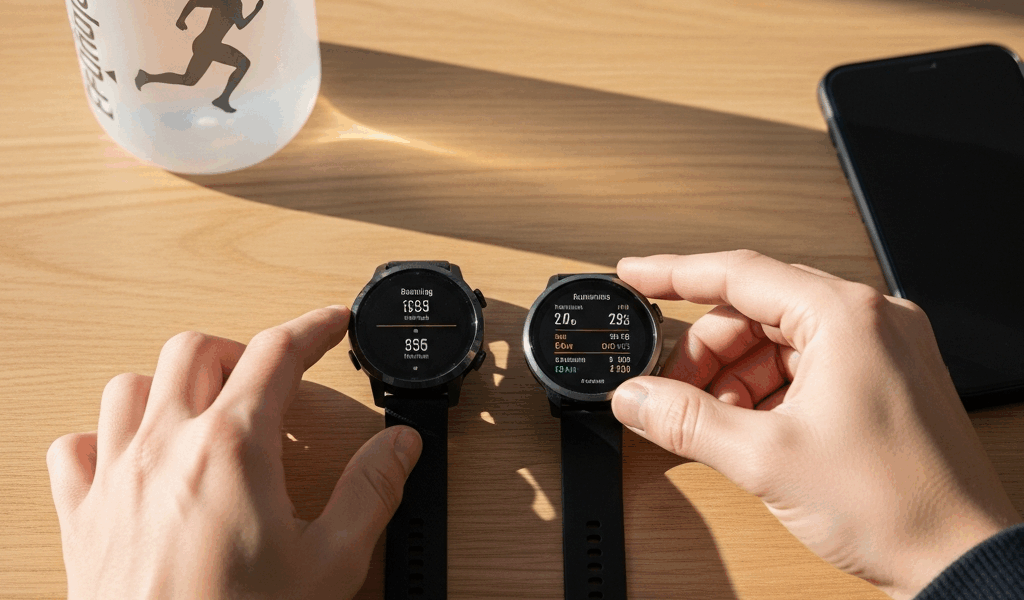
On a regular Tuesday morning run, the 265 and 965 feel almost identical. Both carry AMOLED displays that look sharp in early daylight. Both vibrate at mile splits. Both will gently remind you that your HRV is down and maybe you should take it easy — a suggestion you will absolutely ignore. The 265 screen measures 1.1 inches. The 965 gives you 1.4 inches. Subtle at a glance, genuinely noticeable when you’re trying to read your pace mid-stride without breaking rhythm.
During race week, the gap gets more interesting. The 965 leans harder into training analytics — race predictor times feel more refined when you’ve been feeding it consistent data, and the daily suggested workouts carry more nuance at the higher tier. The 265 handles this well too, but there’s a ceiling. Structured intervals, lactate threshold work, back-to-back hard days — the 965 synthesizes all of it with more granularity. Most runners won’t notice. Serious athletes will.
Post-workout is where I made my biggest mistake early on, honestly. I assumed the data review experience would be identical on both watches. It’s not. The 965’s larger screen makes scrolling through performance condition, ground contact time, and vertical oscillation feel like checking a real dashboard. The 265 makes you work a little harder to surface the same information. Not a dealbreaker — just true.
Battery life behaves differently in real conditions too. Heavy training blocks with GPS on, continuous heart rate tracking, and constant phone syncing will have you charging the 265 every two to three days. The 965 stretches comfortably to four or five. Small thing until it suddenly isn’t.
Where the Forerunner 265 Wins
Worth saying out loud before I go further., because for most people reading this comparison, the 265 is simply the answer.
The 265 gets up to 24 hours in GPS mode with the full AMOLED display running. Drop into battery saver GPS mode and that number climbs toward 31 hours. Marathon runners, half marathoners, anyone racing under six hours — you are not going to run out of battery. Full stop.
The watch weighs 47 grams in the standard 42mm version, 51 grams for the 46mm. Light. Comfortable. Wearable all day without feeling like you’ve bolted a small computer to your wrist. That comfort level actually matters for sleep tracking — you’ll wear it, which means it’ll return useful recovery data instead of sitting on your nightstand.
At $449, here’s what you’re getting:
- Full AMOLED display with always-on capability
- Running dynamics including stride length, ground contact time, and vertical ratio
- Daily suggested workouts powered by your actual training load
- Training readiness score and HRV status
- Garmin Pay and offline Spotify music storage
- Race predictor and PacePro pacing strategy tools
That’s a serious watch. Run five days a week, race occasionally up to the marathon distance, want data-informed training without becoming a full-time data scientist — stop here. Don’t let anyone upsell you.
Who should firmly stay with the 265: road runners, anyone whose longest event is a marathon or shorter, people who want a daily-wear smartwatch that pulls double duty as a training tool, and anyone who feels $150 in their pocket more than they feel the absence of multiband GPS. That’s most of us, by the way.
Where the Forerunner 965 Pulls Ahead
Honest caveat first. Roughly 80 percent of runners will never genuinely need what the 965 offers over the 265. That’s not a knock on the watch — it’s just math.
Multiband GPS accuracy is the most meaningful real-world upgrade here. Standard GPS — what the 265 uses — works beautifully on open roads. Put yourself in a dense trail canyon, under a heavy tree canopy, or running through downtown Seattle, and you’ll watch your track drift. The 965 locks signal from multiple satellite constellations simultaneously and holds tighter to your actual path. Road runners will barely notice the difference. Trail runners who care about accurate segment data and elevation profiles will notice it immediately.
Battery life scaling is the other major argument. The 965 delivers up to 31 hours in standard GPS mode — and up to 110 hours in expedition GPS mode. For ultramarathons, anything overnight, 50 miles or 100 miles, the 265 makes you anxious. The 965 doesn’t. Triathletes doing long-course events need this headroom too. Extended GPS through the bike leg plus the entire run leg of a full Ironman eats battery faster than most people anticipate before race day.
The 965 also delivers more refined lactate threshold estimates and a more detailed breakdown of aerobic versus anaerobic training effect. The difference isn’t dramatic. But if you’re following a periodized training plan — building base phases, then sharpening toward a peak race — you’ll find the 965 gives you more to actually work with.
The 1.4-inch AMOLED on the 965 is also meaningfully brighter in direct sun. Useful when you’re three hours into a trail race in August and squinting at your pace through sweat and sunlight. That display difference is real, not marketing language.
Get the 965 if this profile fits: trail runner doing events over four hours, triathlete racing Olympic distance or longer, athlete training under a structured periodized coaching plan, or the data-obsessed type who opens Garmin Connect every single morning and actually adjusts training based on what they find there.
Final Pick — Stop Overthinking It
Here’s the plain version.
If budget matters even a little, or your longest race is a marathon, buy the Forerunner 265. It will not hold your running back — and the $150 you save buys a lot of race entry fees. If you’re an ultra runner, a triathlete, or a structured-training athlete who will genuinely use advanced analytics and needs multiband GPS accuracy on trails, spend the extra money on the 965. Don’t look back.
Both watches are available through Garmin’s website, REI, Amazon, and Best Buy. The 265 and 965 go on sale reliably during Black Friday, Amazon Prime Day, and occasionally during Garmin’s own promotional windows — typically dropping somewhere between $50 and $75. The 965 at around $525 on sale makes the value math considerably easier. The 265 at $380 on sale is, honestly, almost an unfair deal for what it delivers.
Pick the watch that matches your actual training life. Not the one with the longer spec list.


Leave a Reply