Dyson V15 vs Shark Stratos — Which Vacuum Wins
What You Actually Get for the Money
The Dyson V15 vs Shark Stratos debate is a maze now with all the sponsored reviews and affiliate noise flying around. As someone who bought the wrong model, returned it, and then bought it again after testing both side by side in my own house, I learned everything there is to know about these two vacuums. Today, I will share it all with you.
This article includes affiliate links. We may earn a commission at no extra cost to you.
Our Top Picks
This section includes affiliate links. We may earn a commission at no extra cost to you.
Dyson V15 Detect Cordless Vacuum
Laser dust detection, LCD screen, 60 min runtime
$549.99
Check Price on AmazonShark IZ862H Stratos Cordless Vacuum
Clean Sense IQ, Odor Neutralizer, 60 min runtime
$349.99
Check Price on AmazonThese are not cheap machines. The Dyson V15 Detect runs $549–$599 depending on where you buy it — I grabbed mine from Best Buy for $569. The Shark Stratos (model IZ862H) sits at $399–$449. That $150 gap is real money. Whether it’s justified depends entirely on how you clean and what you’re cleaning.
Here’s the fast answer for skimmers: the Dyson V15 is the better vacuum, full stop. But the Shark Stratos is the smarter buy for a significant chunk of people reading this. Pets, larger home, money isn’t the primary concern? Get the Dyson. Apartment, one dog, want to keep $150 in your pocket? The Shark handles it without embarrassing itself. Everything below explains why.
Suction and Cleaning Performance Side by Side
Hardwood and Bare Floors
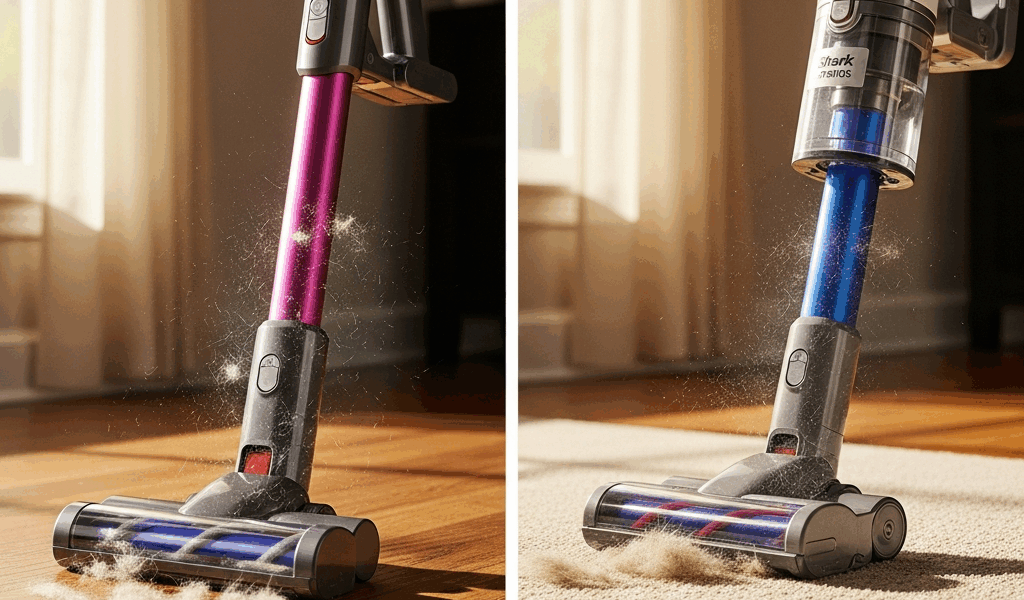
Both vacuums handle hardwood well. But what is Dyson’s laser illumination feature, exactly? In essence, it’s a thin green laser built into the Fluffy cleaner head that reveals dust and debris you didn’t know existed. But it’s much more than that — it genuinely changed how I define “clean.” First time I ran it across my kitchen floor, it lit up a trail of fine particles like a crime scene. Humbling, honestly.
The Shark Stratos has no equivalent feature. Its DuoClean PowerFins head picks up debris in a single pass without scattering it, though. No missed cereal pieces. No pushing debris forward. On hardwood, the Dyson is more satisfying purely because of the visual feedback. The Shark is equally effective. Neither struggled here.
Carpet — Low Pile and Thick
Low-pile carpet is where both vacuums earn their price tags. The Dyson V15 on Auto mode adjusts suction based on surface type — you can watch the LCD screen shift power levels in real time. Sounds gimmicky. It isn’t. On thin carpet, it pulled embedded grit clean in one slow pass. The Shark Stratos requires you to manually bump up suction, but once you do, it keeps pace. The PowerFins brush roll doesn’t tangle the way traditional brush rolls do, which matters more than most reviews acknowledge.
Thick carpet is where the gap opens up. I tested both on a high-pile area rug using a measured quarter-teaspoon of fine sand. The Dyson V15 on Max mode pulled it clean in two passes. The Shark needed four. Not a failure — just a difference worth knowing before you spend $549.
Pet Hair — The Real Test
Worth saying out loud before I go further., since pet hair is why half the people reading this are here. I’m apparently a German Shepherd mix owner and the Dyson’s mini motorized tool works for me while the Shark’s pet multi-tool never quite matched it on upholstery. Don’t make my mistake of assuming they’re equivalent just because both list “anti-tangle technology” on the box.
Both vacuums genuinely resist hair wrapping around the brush roll — that’s not marketing. I checked both brush rolls after extended use and neither had significant buildup. The difference shows up on fabric surfaces. The Dyson’s mini motorized tool is aggressive, pulling embedded fur out of couch cushions efficiently. The Shark’s pet multi-tool relies more on suction than mechanical agitation. On carpet with heavy pet hair, the Dyson wins by a visible margin. On hardwood with pet hair, they’re essentially tied.
Where the Shark surprised me: its odor neutralizer filter. If your home carries a pet smell, the Shark’s filtration actively addresses it. The Shark-cleaned room smelled slightly fresher afterward — a real, noticeable difference. The Dyson filters well but doesn’t compete on odor control the same way. That’s what makes the Shark Stratos endearing to us pet owners who don’t have a German Shepherd leaving fur on every surface imaginable.
Battery Life and How Far It Actually Gets You
Rated battery specs are almost useless without context. Here’s what actually happened in my house. The Dyson V15 is rated at up to 60 minutes — that’s Eco mode, no motorized head attached. Run it the way you’ll actually use it, Auto mode with the full-size Fluffy head, and expect 35–40 minutes. On Max mode, you’re looking at 12–15 minutes. Enough for a targeted blitz, not a full clean.
The Shark Stratos is rated at 60 minutes in IQ mode. Real-world with the motorized head and normal suction: closer to 40–45 minutes. On Max: roughly 20 minutes. The Shark actually edges out the Dyson in practical runtime at moderate settings. That matters more than the spec sheet suggests.
In terms of home coverage: the Dyson V15 in Auto mode comfortably handles a 1,500–1,800 square foot home on one charge if you’re efficient. The Shark Stratos, with its slightly longer real-world runtime, can push toward 2,000 square feet. Both recharge in about 4–4.5 hours. Neither has a swappable battery — a frustrating limitation at this price point, honestly. For homes over 2,500 square feet, plan on a mid-clean charging break regardless of which one you choose.
Design, Weight, and Daily Usability
Picking up the Dyson V15 for the first time after years of using budget uprights, I immediately noticed the weight — and not in the way I expected. The V15 weighs 6.8 lbs. The Shark Stratos weighs 8.7 lbs. Neither sounds heavy on paper. Extended use above your head — ceiling fan blades, high shelves — is where those two pounds become a genuine conversation. The Dyson wins for above-floor tasks, no question.
At floor level, the Shark’s weight is barely noticeable. It has a slightly lower center of gravity in stick mode and maneuvers around chair legs without frustration. The Dyson is nimbler in tight spaces. Both convert to handheld. Both do it quickly. Noise is another gap worth mentioning: the Dyson V15 on Auto is loud-ish but not disruptive. On Max it’s genuinely loud — no conversations happening over it. The Shark Stratos runs quieter across all modes. Not dramatically quieter, but noticeably so. If you vacuum during a sleeping baby’s nap or in a shared-wall apartment late at night, that difference is real.
Dust bin size: Dyson V15 holds 0.77 liters, Shark Stratos holds 0.84 liters. Both empty via bottom-release mechanisms. The Dyson’s release is cleaner — less dust cloud on empty, which matters if you have allergies. The Shark’s bin is easier to remove one-handed. I’m apparently someone who empties after every session and the Dyson works for me while the Shark never quite felt as hygienic about it. Don’t make my mistake of overlooking this detail if you’re allergy-prone.
Attachments: the Dyson V15 comes with tools that earn their place — the hair screw tool, the crevice tool, and the mini motorized head specifically. The Shark Stratos includes a pet multi-tool, self-cleaning brush roll head, and a flexible wand extension I’ve actually used. Both packages are solid. More attachments isn’t better — useful is better — and both brands get this right. That’s what makes both of these vacuums endearing to us people who’ve wasted drawer space on six attachments we touch once a year.
Who Should Buy the Dyson V15 and Who Should Buy the Shark
Heavy pet hair households: Buy the Dyson V15. The motorized mini tool on upholstery and the stronger suction on thick carpet make a visible difference when you’re dealing with fur daily. The laser head also reveals what you’ve been missing — which turns out to be a lot.
Apartment dwellers: Buy the Shark Stratos. You don’t need Max suction mode for 700 square feet. The quieter operation is a real quality-of-life upgrade in shared-wall situations, the bin is slightly larger relative to your cleaning area, and you keep $150. Spend that on something better than a marginal performance difference on hardwood floors.
Large home owners — 2,000+ square feet: The Shark Stratos’ real-world runtime advantage at moderate settings gives it a slight edge, but honestly, at this size you should consider a corded upright as your primary and use either of these as a secondary. If it has to be one cordless: Dyson for carpeted large homes, Shark for predominantly hard floor large homes.
Budget-conscious buyers in this tier: The Shark Stratos at $399 is the answer. There’s no scenario where the Dyson V15 is worth $150 more to someone without a serious pet hair problem. The Shark cleans. It cleans well. The extras on the Dyson are real — just incremental.
One thing I got wrong early on: I assumed Dyson’s LCD display and laser head were gimmicks I’d stop using after a week. I use the laser every single time on bare floors now. That new idea took off several weeks into ownership and eventually evolved into the non-negotiable feature enthusiasts know and rely on today. That detail alone might justify the premium for certain buyers — the kind of person who finds visible results genuinely motivating.
Single sentence verdict: The Dyson V15 is the better vacuum, but the Shark Stratos is the better purchase for anyone without a serious pet hair problem.



Leave a Reply