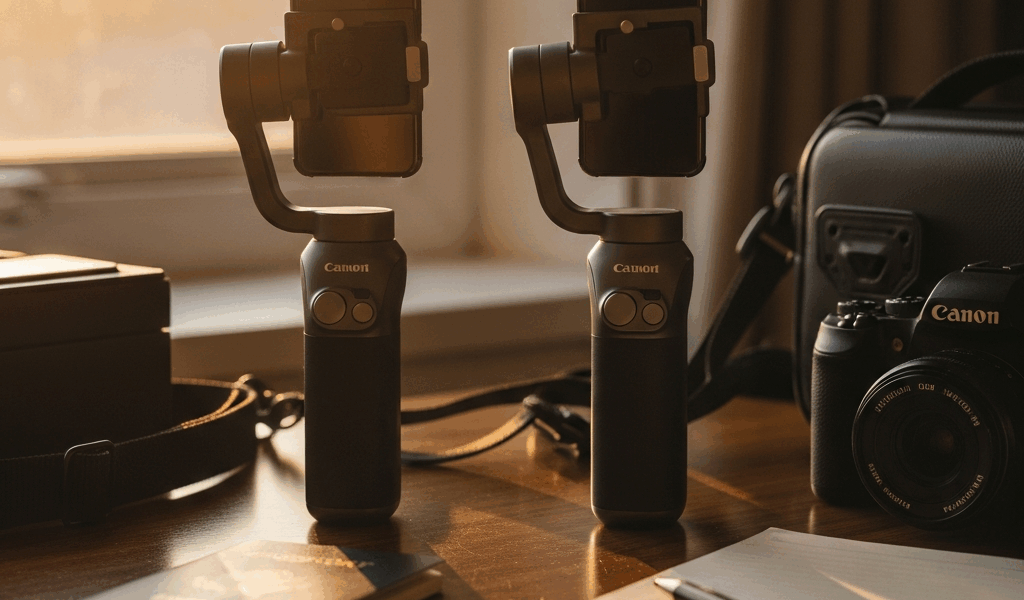
DJI OM 5 vs Osmo Mobile 6 at a Glance
This article includes affiliate links. We may earn a commission at no extra cost to you.
Our Top Picks
This section includes affiliate links. We may earn a commission at no extra cost to you.
DJI Osmo Mobile 6 Gimbal Stabilizer
3-axis phone gimbal with ActiveTrack 5.0, wider 90mm clamp, and built-in extension rod
$159
Check Price on AmazonDJI OM 5 Smartphone Gimbal Stabilizer
Lightweight 290g 3-axis gimbal with magnetic quick-release and built-in extension rod
$159
Check Price on Amazon| Feature | DJI OM 5 | DJI Osmo Mobile 6 |
|---|---|---|
| Weight | 290g | 309g |
| Extension Rod | Built-in, ~215mm extended | Built-in, ~215mm extended |
| Phone Clamp | Magnetic + clip adapter | Magnetic clamp, wider jaw |
| ActiveTrack Version | 4.0 | 5.0 |
| Launch Price | $159 | $159 |
| Phone Compatibility | Up to 84.5mm wide | Up to 90mm wide |
The DJI OM 5 vs Osmo Mobile 6 debate got weird fast with all the half-baked comparisons flying around. As someone who has stood in a camera shop holding both units — more than once, probably more than is reasonable — I learned everything there is to know about these two gimbals the hard way. Today, I will share it all with you. No spec-sheet theater. No “both are excellent in their own way.” You already know you want a smartphone gimbal. You just need someone to point at the right one.
What Actually Changed Between These Two
But what is the Osmo Mobile 6, really? In essence, it’s a one-axis-ahead evolution of the OM 5. But it’s much more than that — at least in a few specific spots that matter during actual shooting.
Launched in late 2022, the OM 6 arrived barely a year after the OM 5. Short runway. DJI still managed to land some real improvements — and a few that sound better in a press release than they feel on location.
The magnetic clamp redesign is the biggest practical upgrade. The OM 5 uses a separate magnetic adapter you stick to your phone, then click onto the gimbal. Works fine. The OM 6 kept the magnetic approach but widened the clamp jaw to 90mm — up from 84.5mm. That extra 5.5mm is the difference between fitting an iPhone 14 Pro Max or a Samsung Galaxy S23 Ultra without an adapter swap. Small number. Big deal if your phone is on the larger side.
ActiveTrack 5.0 is the other jump worth paying attention to. The OM 5’s 4.0 version tracks competently but drops subjects during fast lateral cuts or partial occlusions — think someone passing behind a lamppost or a doorframe. Version 5.0 recovers noticeably faster. The difference isn’t cinematic, but it’s real.
Gesture controls got an upgrade too. The OM 6 recognizes more hand signals — wave to start recording, open palm to snap a photo — without touching anything. Genuinely useful when you’re solo. The extension rod, by the way, is essentially identical on both. About 215mm extended. Some early OM 6 reviews implied this was new. It wasn’t. Don’t let that talking point sway you either direction.
Portability and Build Feel in the Real World
Frustrated by gimbals that fold neatly in product photos but devour half a daypack in practice, I started testing both units on actual travel days — airports, city walking, one very crowded train in Tokyo. The OM 5 wins the portability argument. It’s 290g. The OM 6 is 309g. That’s 19 grams — meaningless on a kitchen scale, noticeable after six hours on your wrist.
More importantly, the OM 5 collapses into a tighter form. Jacket pocket, sideways. Done. The Osmo Mobile 6 does not — at least not without some uncomfortable creative stuffing. Don’t make my mistake: I assumed both packed identically on my first trip with the OM 6 and ended up wedging it into my bag wrong, which scratched the grip finish on day one. It needs a dedicated pouch or the included case. Plan for that.
Build quality feels a step more refined on the OM 6, honestly. The matte texture is nicer to hold. The mode button moved somewhere your thumb actually lands naturally. That said, the OM 5 doesn’t feel cheap — it feels purposeful rather than premium. For travelers counting every gram and every cubic centimeter, the OM 5 is the honest call. For someone shooting mostly from a fixed spot — café table, passenger seat, hotel room — the OM 6’s build quality will feel worth the extra weight.
Shooting Performance and Stabilization Compared
Skipping ahead to the part you want. Both gimbals handle walking shots well. That’s the baseline at $159. The real differences live in three places: low-light panning, fast subject tracking, and portrait-to-landscape switching.
Low-light panning is smoother on the OM 6. During a night market test with an iPhone 14 Pro, horizontal pans on the OM 6 came out clean. The OM 5 was close — but on very slow pans, faint micro-corrections showed up in the footage. You’d only catch it on a monitor, not a phone screen. Still.
ActiveTrack 5.0 genuinely beats 4.0 for anything moving unpredictably. Kid at a birthday party. Dog cutting across a yard. Skateboarder. The OM 6 holds lock longer. The OM 5 drops the subject and takes roughly two to three seconds to reacquire. Not a disaster. Just a pattern you’ll notice over time.
I’m apparently an obsessive portrait-to-landscape switcher — mid-video orientation flips are something I do constantly — and the OM 6 works for me while the OM 5 never quite kept up with the pace I shoot at. The OM 6’s updated motor calibration handles the transition faster. Casual shooters won’t care. Active vloggers switching modes mid-clip will feel the difference immediately.
The DJI Mimo app runs both units — same interface, same feature set. It’s solid on iOS. On Android it has occasional lag during mode switches, which is a platform issue more than a hardware one. Affects both gimbals equally, so it’s not a tiebreaker either way.
Which One Should You Actually Buy
Budget-Conscious Buyers
Both launched at $159. The OM 5 now regularly hits $109 to $129 refurbished or on promotion. The OM 6 holds closer to $149. At $109, the OM 5 is an exceptional buy. The OM 6 is not worth full price over it — unless the 90mm clamp or ActiveTrack 5.0 specifically solves a problem you have.
Travelers and Commuters
Buy the OM 5. Lighter, packs smaller, performs at roughly 90% of the OM 6 across every scenario you’ll actually shoot while moving. That’s what makes the OM 5 endearing to us travel shooters — it just disappears into your kit. The OM 6 is the better gimbal. It’s not $40 better when you’re also weighing bag space.
Vloggers and Content Creators Shooting Varied Subjects
Buy the Osmo Mobile 6. ActiveTrack 5.0, faster orientation switching, and the improved gesture controls all show up regularly when you’re shooting varied content solo. These aren’t edge-case features — they’re the exact situations vloggers land in constantly.
iPhone vs Android Users
iPhone users get more out of both gimbals. Mimo runs cleaner on iOS, and ActiveTrack 5.0 integrates more effectively with Apple’s camera system. Android users will find the hardware gap between OM 5 and OM 6 matters less — app-side limitations level the field. The upgrade is harder to justify on Android at full price.
So, let’s land on a verdict: the DJI Osmo Mobile 6 is the overall winner for anyone paying full price and shooting regularly. It’s the tool you won’t outgrow in six months. But the OM 5 at $109 is the one I’d hand to a traveler without a second thought. Buy based on your actual situation — not the spec sheet.


Leave a Reply