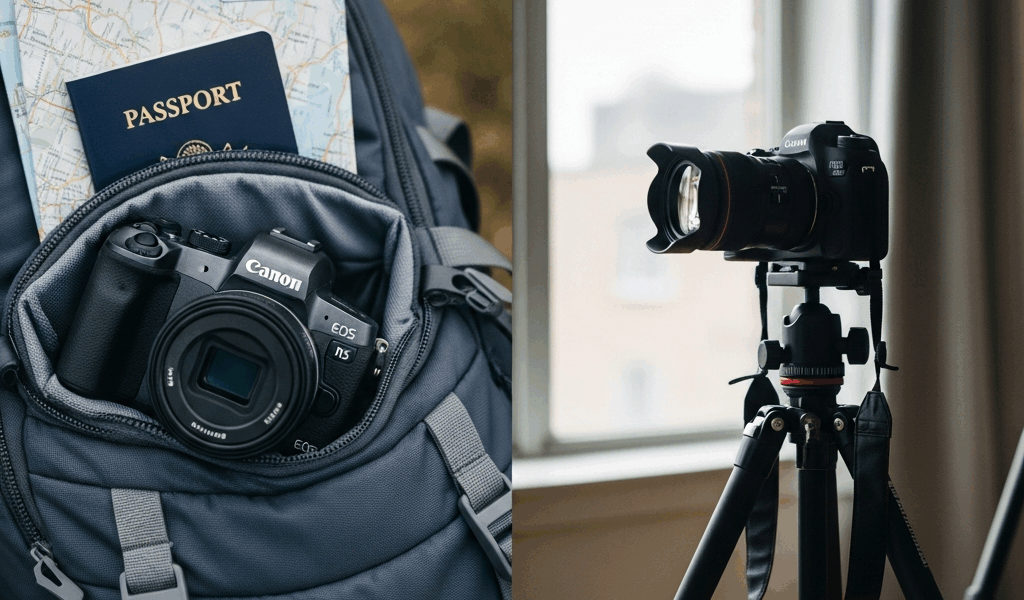
Quick Verdict — Who Should Buy Which Camera
The Sony A7C II vs A7 IV debate is genuinely confusing these days with all the spec-sheet noise flying around. So here’s the short version: get the A7C II if you travel, shoot hybrid video, or need something that actually fits in a jacket pocket. Get the A7 IV if you shoot portraits, studio work, or wildlife — and want a traditional body with controls that don’t make you hunt around. That’s it. Everything below explains the why — and catches the edge cases where that answer flips entirely.
This article includes affiliate links. We may earn a commission at no extra cost to you.
Our Top Picks
This section includes affiliate links. We may earn a commission at no extra cost to you.
Sony Alpha 7C II Full-Frame Mirrorless Camera
Compact 33MP full-frame body with 4K 60p video, 7-stop IBIS, and AI-based subject recognition
$2,198
Check Price on AmazonSony Alpha 7 IV Full-Frame Mirrorless Camera
Traditional-grip 33MP full-frame body with dual SD slots and BIONZ XR processing
$2,498
Check Price on AmazonSize and Handling — The Real Difference
This is the differentiator most comparison articles bury at the bottom. It shouldn’t be.
The A7C II measures 124 x 71 x 63mm and weighs 514g with battery and card loaded. The A7 IV comes in at 128.9 x 96.4 x 77.5mm and tips the scale at 659g. That’s a 145-gram difference. Doesn’t sound dramatic. Tell that to your shoulders six hours into a shoot day in Lisbon.
Frustrated by how cramped the grip felt on a borrowed C-series unit a couple years back, I wrote these bodies off entirely. That was a mistake — one I kept making until I actually paired the A7C II with the 28-60mm kit lens it was designed around. For someone with average to smaller hands, the grip works fine. Pair it with a 70-200mm f/2.8 GM and it stops working fine. The balance goes wrong fast, your hand fatigues somewhere around hour two, and you’ll wish you had the deeper A7 IV grip underneath you.
The A7C II uses a rangefinder-style body — flat top, no pentaprism hump, smaller overall footprint. The A7 IV goes full DSLR-style — taller, deeper grip, more real estate for your fingers. It also has a dedicated exposure mode dial on top, a proper AF joystick, and the layout of a camera designed for someone shooting all day. The A7C II has a mode dial too, but it’s recessed and smaller. Not a dealbreaker. Just a trade-off you should know about before you’re standing in a field at golden hour trying to find it by feel.
Street photographers and travelers get the most out of that compact form. Studio shooters, portrait photographers working on tripods, anyone running heavy adapted glass — they should seriously weigh whether 145 grams is worth the handling compromise.
Image Quality and Video — Where Each Pulls Ahead
Both cameras run a 33-megapixel full-frame BSI CMOS sensor — same generation, same class. Print them side by side at 24×36 inches and you cannot tell the difference. That’s not a hedged statement. Sony’s own marketing quietly acknowledges this by never making sensor differentiation a selling point between these two.
High ISO is essentially a wash as well. Both hold clean files through ISO 3200. Both become usable with noise reduction through ISO 12800. Neither is a low-light specialist the way the A7S III is — but both are genuinely good.
Autofocus is where things get interesting. The A7C II ships with Sony’s current AI-based subject recognition — humans, animals, insects, vehicles, aircraft. The A7 IV launched in late 2021 and has received firmware updates that helped considerably, but the A7C II’s recognition is noticeably more confident in cluttered or mixed backgrounds. Shoot a subject moving through a crowded street market and the A7C II locks and holds more consistently. Not a night-and-day gap. But it’s real.
Video is where the gap becomes impossible to ignore. The A7C II shoots 4K at 60fps. The A7 IV caps at 4K 30fps. For anyone producing YouTube content, wedding films, travel videos — any hybrid workflow where slow motion adds production value — the A7C II wins this outright. Shoot at 60fps, slow it to half speed in a 30fps timeline, retain full resolution. That’s not a small thing. That single capability justifies the A7C II for a huge chunk of people reading this right now.
Both cameras shoot 10-bit 4:2:2 internally. Both have S-Log3 and S-Cinetone. The one video edge the A7 IV holds is slightly better heat management during extended recording — useful if you’re doing long uncut interviews or multi-hour event coverage. Otherwise, the A7C II takes video. And it’s not close.
Price Gap — Is the A7 IV Worth More
This is the part you actually came for., because for a lot of buyers it ends the conversation before anything else matters.
As of mid-2025, the A7C II retails around $2,198 USD body only. The A7 IV sits at approximately $2,498 — a $300 premium. Both prices move around. I’ve seen the A7 IV dip to $2,299 during Sony sales events. Check B&H and Adorama before assuming the gap is fixed, because it isn’t always.
What does that $300 actually buy on the A7 IV? A deeper grip. Dual SD card slots — the A7C II runs single slot only, which matters enormously if you shoot weddings or any paid assignment where card failure means a conversation you never want to have. Slightly better rated battery life, 610 shots versus 550, though real-world performance on both lands closer together than those numbers suggest. A more complete physical control layout with the dedicated AF joystick and a second command dial that sits naturally under the thumb.
Here’s the honest take: if you’re a working professional and dual card redundancy is non-negotiable, the A7 IV earns that $300 premium on that single feature alone. If you’re an enthusiast or hybrid shooter who edits everything on a timeline and has never had a card fail mid-job, you’re paying $300 for ergonomic preferences. That’s a personal call. Not a clear value equation.
Used market changes things considerably. A7 IV bodies in excellent condition run $1,800–$2,000 on MPB and KEH right now. A used A7 IV at $1,900 versus a new A7C II at $2,198 is a genuinely different decision than the new-to-new comparison — and one worth making if you’re not attached to the warranty.
Who Should Buy Which Camera
Buy the A7C II if —
- You travel frequently and camera weight actually changes what you bring out the door
- You shoot hybrid photo and video and 4K 60fps fits your workflow or content output
- You have average or smaller hands and shoot with lenses under 400g most of the time
- You want Sony’s most current AF system without stepping up to A9-series pricing
Buy the A7 IV if —
- You shoot portraits, studio work, or events where you’re stationary and long-session handling comfort is a real factor
- You run heavy glass — 70-200mm f/2.8 GM, 100-400mm, adapted lenses — where the deeper grip gives you actual leverage
- You need dual card slots for professional redundancy on paid assignments — at least if losing a card would cost you a client
- You prefer traditional DSLR-style layout and find rangefinder bodies awkward to operate under pressure
Neither camera is a wrong choice. They share the same sensor, nearly identical AF performance in most conditions, and the same color science across the board. The decision really comes down to body size, 4K 60fps, and whether dual card slots belong in your workflow. Check current pricing at B&H Photo or Sony’s official store before pulling the trigger — the gap shifts often enough that timing your purchase by a few weeks can genuinely matter.


Leave a Reply