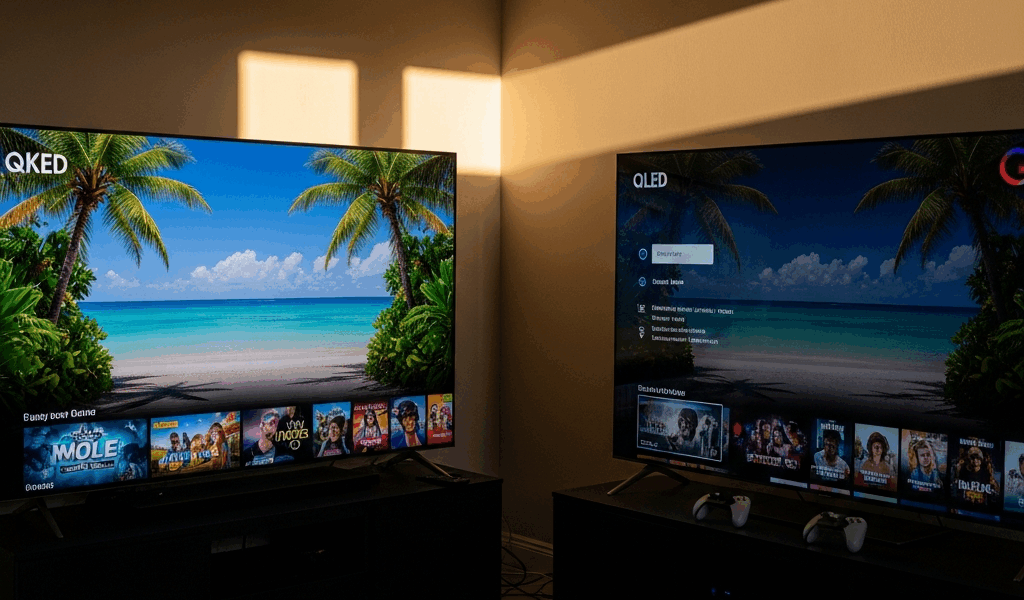
QLED vs OLED at a Glance
This article includes affiliate links. We may earn a commission at no extra cost to you.
Our Top Picks
This section includes affiliate links. We may earn a commission at no extra cost to you.
Samsung 65-Inch Class Neo QLED 4K QN90C
Bright-room flagship with Quantum Matrix Mini LEDs, 1,800+ nit peaks, and full-array local dimming
$1,499
Check Price on AmazonSamsung 65-Inch Class OLED 4K S90C
QD-OLED with quantum-dot color, infinite contrast, and Object Tracking Sound Lite
$1,599
Check Price on Amazon| Category | Samsung 65″ QLED | 65″ OLED |
|---|---|---|
| Peak Brightness | Up to 2,000–4,000 nits (QN90C) | 600–1,000 nits typical |
| Contrast Ratio | Very high (local dimming) | Infinite (pixel-level off) |
| Burn-In Risk | None | Low to moderate over time |
| Price Range (65″) | $900–$2,200 | $1,300–$2,800 |
| Best Use Case | Bright rooms, gaming, mixed content | Dark rooms, movies, HDR content |
The Samsung 65 inch QLED vs OLED debate feels harder to navigate every year with all the spec-sheet noise flying around. As someone who has spent real time with both panel types — in actual living rooms, not showrooms where every TV looks like the face of God — I learned everything there is to know about what separates these two technologies in practice. Today, I will share it all with you. The right answer depends almost entirely on your room and your habits. Not the numbers on the box.
Bright Room Performance
QLED wins here. Full stop.
Picture a Tuesday afternoon. South-facing windows. Sunlight pouring in and hitting somewhere between 1,000 and 3,000 lux near the screen. An OLED panel sustaining maybe 700–800 nits in real-world conditions gets completely washed out in that scenario. The image goes milky. You start squinting. You crank the brightness setting and it still looks like you’re watching through a frosted pane of glass.
Frustrated by how genuinely bad my own OLED looked during an afternoon NFL game, I grabbed a $25 lux meter off Amazon and started measuring my living room. The wall behind the TV was reading 2,200 lux on a clear afternoon. No OLED — at any price — was going to win that fight. That one $25 purchase permanently changed how I think about buying televisions.
The Samsung QN85B and QN90C are the specific models worth your attention for bright-room use. The QN90C at 65 inches hits a measured 1,800–2,100 nits in HDR boost mode, with full-array local dimming spread across 500-plus dimming zones doing actual work. That’s not a marketing number. That’s the difference between an image that pops when a cloud shifts outside and one that just disappears. The QN85B is the entry point — around $1,100 to $1,300 for the 65-inch panel. Direct afternoon light for more than a few hours a day? Start there.
Movie and Dark Room Picture Quality
Real talk: this is the important bit. It’s where the real emotional stakes of this debate live. Cinema people care about this more than anything else on the spec sheet.
OLED wins here, and it’s not subtle. The infinite contrast ratio isn’t marketing language — it describes something physically real. When an OLED pixel goes black, it turns off entirely. Zero light output. So when a scene in Dune cuts to a dark desert night with a single light source on screen, the surrounding blacks are genuinely black. Not dark gray. Not “dark enough.” Black. Shadow detail in HDR content is preserved in a way that no LED backlight system — regardless of how many dimming zones it claims — fully replicates.
The LG C3 and Sony A80L are the benchmark 65-inch OLEDs Samsung is competing against in this space. Both are exceptional panels. Samsung also sells its own OLED line — the QD-OLED S90C and S95C — which layer quantum dot color technology over OLED’s pixel-level contrast. The S90C at 65 inches runs around $1,500 to $1,800 and produces color volume that makes the LG C3 look slightly muted side by side.
The honest reality for dark-room movie watching: any modern 65-inch OLED outperforms any QLED in perceived image depth. The gap is visible, not imaginary. It matters most in content that actually uses HDR with intention — prestige television, 4K Blu-ray, Dolby Vision streams. If that’s your primary use case and you can control the light in your room, OLED is the better screen. It’s not close.
Gaming on a 65 Inch QLED vs OLED
This section has more nuance than the others, so bear with me.
Both panel types support HDMI 2.1 now — meaning 4K at 120Hz, Variable Refresh Rate, AMD FreeSync, NVIDIA G-Sync compatibility on the right models. Input lag in game mode on both is well under 10ms. The Samsung QN90C measures around 5.8ms. The LG C3 OLED comes in around 1.3ms. For competitive play, OLED’s response time advantage is real and measurable. For someone playing single-player campaigns or even most multiplayer titles, it’s not something you’ll ever actually feel.
Burn-in is the actual dividing line for gamers. That’s the conversation.
Static HUD elements — health bars, minimaps, ammo counters, waypoint icons — sit in the same screen position for hours at a stretch. On OLED panels, those elements carry a genuine long-term retention risk once the TV accumulates around 1,500-plus hours of the same content in the same positions. The risk is low in year one. It compounds. Casual gamers putting in a few hours a week are honestly fine. Someone running six-hour sessions of the same competitive shooter four nights a week should think hard before committing to OLED.
QLED has no burn-in risk. Zero. That’s a practical advantage for heavy gamers that no response time spec erases.
For Samsung specifically: the QN90C and QN85B have excellent dedicated gaming modes. Samsung’s Game Bar overlay gives quick access to VRR settings, HDR tone mapping controls, and input lag readouts. The QD-OLED S90C also has a strong game mode and is worth a look for gamers who want OLED image quality inside Samsung’s gaming ecosystem — with the burn-in caveat still firmly attached.
Which One Should You Actually Buy
Here’s the decision breakdown. I’m going to make it as direct as possible.
- Bright living room, mixed content, no dedicated home theater setup — Buy the Samsung QN90C 65″ QLED. Around $1,400 to $1,600 at current pricing. It will look better in your actual room than an OLED costing $400 more.
- Dark room, serious about movies and streaming, watching films most nights — Buy an OLED. Samsung’s QD-OLED S90C at 65 inches or the LG C3 are both exceptional. Budget $1,500 to $1,800. The picture quality difference is real and you will notice it every single time you sit down.
- Heavy gamer, long sessions, same titles repeatedly — Buy the QLED. Burn-in risk on OLED is not zero, and it is not worth the slow-building anxiety. The QN90C’s game mode is excellent, and its brightness advantage genuinely helps in gaming setups where a desk lamp is usually running.
- Mixed-use gamer who watches movies in a reasonably dark room — The Samsung S90C QD-OLED is the real compromise pick here. Better brightness than traditional OLED, better blacks than QLED. The burn-in caveat still applies — use screen savers and pixel shift features and actually turn the TV off occasionally.
The price gap at 65 inches has narrowed significantly. Two years ago, OLED commanded a $600 to $800 premium over comparable QLED. Today the difference between a QN90C and an S90C or LG C3 on sale is often $300 to $400. Meaningful, but not prohibitive — at least if your use case genuinely calls for OLED.
Don’t make my mistake. I bought based on peak brightness specs without measuring the room I was actually putting the TV in. A dark, light-controlled basement would have made OLED the obvious call. My open-plan living room with west-facing afternoon sun made it the wrong one entirely. I’m apparently the kind of person who learns this lesson the expensive way, and a $25 Amazon lux meter works for me now while any amount of spec-sheet reading never did. Grab one before you buy. It will tell you more than any review.
QLED is the smarter buy for most real living rooms. OLED is the better screen when the conditions let it be. Know your room, know your habits — the technology to support either decision exists right now at 65 inches, at prices that would have been impossible three years ago. So, go measure that room.


Leave a Reply